Monday, 14 July 2014

The Wild Coast of Sefton


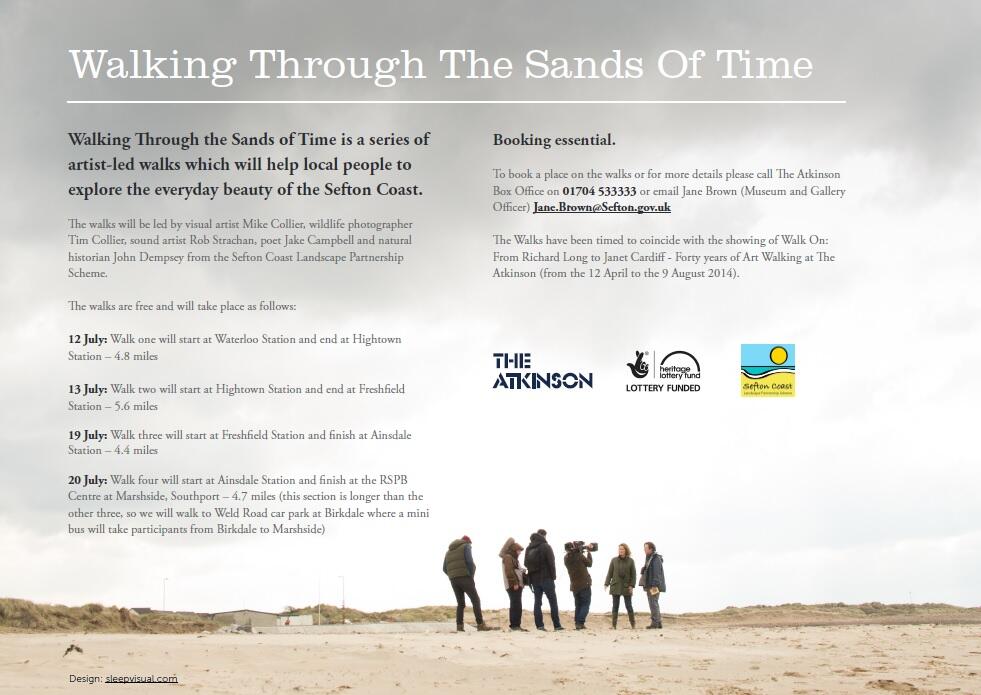
“Frying eggs smell like hope”, I wrote on Twitter, from a greasy spoon in Formby at 11 o’clock on Sunday morning, waiting to join the rest of the group for day two of Walking Through the Sands of Time, a four-day series of artist-led walks along the Sefton Coast, from Crosby – famous for Antony Gormley’s beach-men, Another Place – to Southport, some twenty miles north.

After a hiccup-free first day of travelling, taking 90 minutes from the door of my flat in Chester to the meeting point at the car park by the Marine Lake in Crosby, I was perhaps being a bit complacent thinking I could repeat the same feat of good fortune on day two. I was: Merseyrail, like many transport networks, operate less frequent services on the day of rest. I managed to get away by 9, only 15 minutes later than the previous day, but my second mistake swiftly followed, when I found myself at Kirkdale, heading towards Ormskirk, not Hightown, the day’s designated meeting point.


I hastily left the train, half-scoffed banana in hand, making a 180° trundle over the footbridge. Next train not for 17 minutes. Hmm. I was keen not to be late – or much later than I already was – so I asked a bloke in the waiting room if he had a local taxi number, in the vague hope that I could stump up a fiver and not be terminally late. “Metro Cabs are the best, mate, but I can’t remember their number. Trade-unionised, though, so you get the best rates. Sorry, pal. You from the North East are ya?” Cab was going to knock me back fifteen quid and take as long as the back-tracked train journey, so I sat, waiting for the yellow and grey carriage to roll in and get the day started, staring across the platform, cursing myself for not knowing the name of the ubiquitous lilac bushes that had followed me up the line, from Bache to Birkenhead. Buddleja, I later (re)learned.


Cue the Greasy Spoon, and directions from the weekend girl, whose instructions to “just keep going through the forest” turned out to be about as accurate as anything I’ve ever received in that department. I slurped the last dregs of tea and made my way towards Lifeboat Road, and the delayed start to the day.

*

There are three cities in the UK which, to my mind, are nearly one and the same: Newcastle, Liverpool and Glasgow. While all have their differences and idiosyncrasies, there are three, key shared characteristics which I think make them startlingly similar: their proud river heritage; their love of football; and most importantly, the spirit of their people. In this case, I want to think about the river: the Mersey, gushing out into the Irish Sea, bordered for much of its length by the Wirral, and famed for its ships and dockyards. When you get the train out of Moorfields on the Northern Line, you pass a landscape of old tobacco factories and grain silos; cavernous old docks are watched over by wind turbines and recycling depots. And the train speeds through Bootle New Strand and Seaforth and Litherland; and you see great Victorian pubs with weeds in their gutters; and you see rows of tumbledown houses where shipyard workers used to call home; and you see more modern social housing, with row after row of trampolines and ladder-clad Transit vans parked outside. And if you’re from Newcastle (or Glasgow), but in this case Newcastle, you feel like you’ve just got on the Metro to the Coast at Monument and whizzed through Manors; and at Byker you’re looking down at the Ouseburn and its vestigial chimneys; and at Wallsend you’re looking at the same rows of Victorian terraces, with their identikit trampolines and barbecues; and at Tynemouth you go underground again, briefly, as the train chugs by the James Knott Flats, you think of similar 30s structures at Bank Hall and Blundellsands; and depending on where you are, you either look West or East and there’s sea: thick, grey and apparently motionless; and beyond it, a Northern sky, with its clouds the colour of concrete and its punctuation marks of wind farms, or marker buoys, or cargo ships.


*

Sefton. 1995. Brookside Close. Jimmy Corkhill; Tin’ead; double-denim. These are the things I associate with this coast — a TV exec’s 90s pastiche of life in Liverpool. Which is to say that really, I associate nothing with this part of the world. If you’d asked me a week ago what was between Liverpool and Blackpool on the North West coast I’d have shook my head. Not a Scooby. This is why we walk: why we butter our sandwiches at 8am on a Saturday; sausages and dippy eggs for breakfast. Why we Google map the area and try on for size the place names on our tongue: Formby, Ainsdale, Southport. But none of that prepares us. Until we stand on the wild coast, sand in our shoes, sunburn on our hamstrings, we don’t really know what’s here, nor what it means, could mean.


*

“I’m setting out, armed with curiosity rather than expertise, to pay a different kind of attention to what I see” writes Jean Sprackland in her preface to Strands, her ‘year of discovery’ on the Sefton Coast. “I hope to cut through the blur of familiarity,” she continues, “and explore this place as if for the first time. Some of my finds may be real surprises, and others more predictable; but I shall pick them up and hold them to the light, regardless.”


Oh, Jean, what am I doing here, at half past eleven on a Sunday morning, in a sleepy commuter belt, searching for a path I don’t really know, to meet people I don’t really know, to trundle over more sand dunes that I don’t really know?

These are the questions I ask myself on Lifeboat Lane, Formby, by St Luke’s Church, which I later learn was once nearly entirely covered in sand during a particularly fearsome storm. It’s a story you’d think more than just a bit hyperbolic, until, on Ravenmeols Dunes, you see the size of these beasts. Piles of sand, netted in Marram and Sea Holly, as high as my four-storey apartment block. This is when you begin to believe the submersion of St Luke’s, drowned in sand, proper biblical.


Formby lies below sea level. It relies on mountainous dunes and rigid Pines. Formby smells of wind-whipped sand and money: Gerrard and Rooney both have houses here; Shearer lived in the area during his tenure at Blackburn Rovers. Rivers, football, people. On a lamppost, I spot a warning sign for a rogue-trader, known to have conned locals into dodgy swimming pool installation. Your average cowboy brickie, he is not. Google Earth Formby and you’ll see a lot of blue rectangles in gardens. Trampoline country this is not.


*

In the 1955-56 season, Manchester City beat Birmingham City in the FA Cup Final. What’s remarkable about this game is not so much the score line, but the fact that Manchester City’s goalkeeper, Bert Trautmann, played the last fifteen minutes of the game with a broken neck. Football trivia aside, what you learn at Hightown, if you’re being guided by natural historian John Dempsey, that is, is that only metres back from the high tide line of the beach, half hidden beneath Pyramidal Orchids and Sea Buckthorn, lies the remains of Fort Crosby, where Trautmann was interned as a prisoner of war during World War Two. And two or three miles north, covered in a different kind of thicket – that which comes in a mist from a paint can to expresses social discontent – is a store house for Operation Starfish, when, during the War, dummy fires would be lit in the country to resemble the shape of nearby port cities, the thinking being that enemy bombs would drop early, ideally causing plumes of sand rather than plumes of munitions, and bodies.


*


And you stand and watch the tide roll out, which it does quickly, the markers growing by the inch every minute, erect like giant fly swatters or cocktail sticks; and on the wind you hear the crack and whizz of bullets from the rifle range at Hightown; and at Altmouth the lazy boats slumber into marshes as the breeze strums their riggings in cowbell clatter; and a few dog walkers litter the coast, along with the rubble of blitz-bombed Liverpool and cooking oil drums chucked overboard from some distant tanker in the Atlantic; and the skyline of Liverpool, its cathedrals and Radio Tower, are silhouetted to the South as the wind makes a marathon dash for the Mersey and you think of the opening scenes of Atwood’s dystopia, Oryx and Crake, all howling winds, jetsam and distant, empty skyscrapers; and the clouds lift, the sun opening them like blinds, to show you Hoylake, Flintshire, Snowdonia. And you stand, with your face to the sea, arms at your side like the Gormleys, asking yourself what it is you’re shoring up against, out here, on the wild coast of Sefton.


Monday, 7 July 2014

Walking Through the Sands of Time


Over two weekends in July – the 12th and 13th and 19th and 20th – I will be taking part in WalkingThrough the Sands of Time, a series of artist-led walks that will help people to explore the natural beauty of the Sefton coastline, following a path of just shy of 20 miles from Waterloo, Merseyside, to the RSPB centre in Marshside, Southport.

There are still places available to join the walks, where participants will be encouraged to contribute to the resulting artworks, offering their thoughts and feelings on the route and its landscapes and what they come across. As well as being welcome to take part in the physicality of the walks, there will be opportunities to be guided in photography, sound artistry and writing about place under the tutorship of myself and the other artists and guides: Mike and Tim Collier, Rob Strachan and the local expertise of natural historian, John Dempsey.

As I take part in these walks, I will update accordingly with any writings and pictures, eventually bringing into life some new work about the area. As I’ve never been to the area, I can’t really add anything else yet, so stay tuned for my first foray into Sefton and its sands. As a Sanddancer, I’m sure I’m going to be in my element!


To book places on the walks, or for more information, please phone The Atkinson on: 01704 533333.

Monday, 9 June 2014

Butcher's Dog Issue 3 (is ACE!)

Butcher's Dog issue 3, cover art by Laura Hol.

This weekend saw me return to Newcastle for the launch of the third issue of Butcher’s Dog, which I’ve spent chunks of the past 3 months editing alongside Sophie F Baker and Amy Mackelden, two very good writer friends whom I know from what now seems like ‘my other life’ in the North East.

The launch event – at the fantastic Toffee Factory down by the Ouseburn, which, as this article suggests, has had an interesting history as a building, most pleasingly as an actual sweet factory – as well as the preceding workshop, ‘Moments of Epiphany’, in which me and Amy got our participants furiously scribbling about transformative moments in their lives, was everything a poetry event should be: full of good people reading interesting work in a relaxed setting; the formation of new friendships and connections; and, of course, the after-party, which saw several of us quaffing craft beer and local steak pies ’til dusk in Newcastle’s best pub, The Free Trade Inn.

It was a significant Butcher’s Dog event for me, having not been able to make the launches of our previous two issues, which, I’m told, were equally well put together and attended events. The Dogs, as we’ve now started calling each other, formed this magazine on the back of workshops led by Clare Pollard and facilitated by New Writing North; and at the time, while we were all keen, I don’t think any of us would have envisaged it becoming as successful as it now has. Those successes could be measured statistically – by the bums we’ve had on seats, the copies we’ve sold, the subscribers we’ve got, or even the Arts Council funding we’ve secured – but I think it’s in talking to people at these events, which are clearly very appreciated, and hearing good feedback, that I realise that what I’m a part of is something much more significant: a poetry collective, yes, we are that, but I think we are one which extends our support and encouragement outwards, and while I’m sure all collectives say that, I genuinely think that Butcher’s Dog is a force for good not just for new and established poets in the North, but for writers, artists and thinkers across the country; for people who like to be challenged, entertained and – dare I say it – sometimes even amazed by the power of good a beautiful, tactile little magazine can do.


As for the future, submissions are open for issue 4 until the 10th August, so I would encourage everyone, not just Northerners, to submit. There’s going to be a London launch on the 7th August, too, so that our many Southern friends and contributors can be part of the fold. I’ll tweet details about that as I get them. For now, if you haven’t already seen it and my naval-gazing hasn’t scared you off, I’d just prod you towards this link, where copies are available. I would say it’s worth it, but I think you probably already got that one...

The editors in the pub. L-R: Amy Mackelden, me, Sophie F Baker

Tuesday, 1 April 2014

Review: 'Translations', Northern Stage, Saturday 29th March 2014


But remember that words are signals, counters. They are not immortal. And it can happen – to use an image you’ll understand – it can happen that a civilisation can be imprisoned in a linguistic contour which no longer matches the landscape of... fact.”

Brian Friel has said that Translations is a play essentially about language, and I think he’s right to say that, but only if we accept that it is language which we primarily use to facilitate relationships — both those that we desire and those that we fear.

For those who have seen the play on stage, which I did last weekend at Northern Stage in Newcastle, you will be aware that by ‘language’, I am not simply talking about the words we speak to each other: I am thinking about the whole physical process and significance of language, and, crucially, what can happen in its absence. The character of Sarah, who might be said to embody the genius loci of the play, is seen in the opening scene being taught to say her own name by Manus, the lame scholar who fills in for his father, Hugh, head of the hedge school in fictional Baile Beag in rural North West Ireland where an intriguing mix of arithmetic and Classics is taught to an eclectic group of students.

“My… my na… my name. My name is… Sarah” we hear her exclaim to a clearly-delighted Manus, whose life is about to be shattered by words: their often simultaneous meanings and confused implications.

Captain Lancey and Lieutenant Yolland have arrived from England along with a “trained army” to conduct the first Ordnance Survey of the country, mapping six inches to the mile, for the benefit of the people of Ireland, the Empire and fair taxation. Or so tells Roland – actually Owen, Manus’s entrepreneurial brother, returning from Dublin after 6 years away – to the assembled class, where he acts as translator between his own people, fluent only in Gaelic and broken Greek and Latin, and not the King’s English being dictated to them by the arrival of the mapmakers.

If for Friel this is a play about language, for me it is a play about doubling, duality. The elephant in the room, of course, is our acceptance that we, an English audience, are watching and clearly listening to English-speaking actors pretending to speak Irish, and/or speaking an exaggerated version of King’s English, themselves failing to understand each other, even though every word in the play is intelligible. But that’s the core thematic doubling, one which is so obvious we quickly forget it. Others are more subtle. Owen – Roland – is the embodiment of how these reflections slowly manifest: a character who, when he first strides on to stage in a plush cream suit, so vivid, so clean and full of colour compared to the tatty garments the others wear, is instantly seen as a man of the ‘new’ Ireland: that of cosmopolitanism and commerce – not potatoes and pigs. And frolicking, drunk on poteen, with Yolland, casually coining new names for the places he has left behind, we might be forgiven for thinking that is all he is: someone who has ‘made it’, found a new life and wealth for himself. But, no: Owen, acting under the jurisdiction of Colonial Rule, becomes a man divided; a man who can conjure new names with the swipe of a pen, but is unable to forget the folktales and legends that are connected to the old ones. A man, therefore, quite literally caught between his past and his present – and, by association, his future.

He is, in many ways, the brother Máire – equally caught in a state of transition, or desired transition – should have been with: savvy, worldly, some might go as far as to say a ‘sell-out’, Owen has the spirit of adventure that Manus lacks. But is it Manus’s conservatism, or Máire’s ambition, that leads to their inevitable downfall? Complicatedly, it is both and neither: Máire’s desire to learn English, to begin a new life in America, where she won’t need worry about potato blights, is both a reaction to Manus’s stubborn desire to ape his father, and a consequence of a changing society more broadly – one which is literally and spiritually losing its connections to the land.

Readers familiar with my past theatre reviews will know that I am not trained in dramaturgy and such other technicalities, so my reactions to performance and the craft of staging and acting are based more on instinct that experience. One of the most intrinsically beautiful scenes in Translations occurs when Yolland and Máire flit off after the dance and attempt to show their lust to each other. And it is lust, not love: Yolland yearning for a rural quiet that his work seeks to undermine; Máire foolishly believing Yolland could whisk her away, hiccup-free, to a brave new world. In a symbolic moment of linguistic beauty, and another obvious example of doubling, they try to decode their language barriers, Máire inferring: “The grass must be wet, my feet are soaking”, to which Yolland unironically retorts: “Your feet must be wet, the grass is soaking.” This rhetorical device builds towards its conclusion, with Máire and Yolland speaking to understand, not to be heard. “Always”, they both say in their respective mother tongues, the word loaded with irony and foreshadowing.

There are many other examples throughout the play, most of them stemming from the double meanings to be found in abundance within Friel’s allusion-heavy text. Jimmy, a character who I’ve not mentioned, but who plays a key role and might be seen to represent the antithesis to the dumb Sarah, is a figure almost transcendent of the very specific time and space in which the play is set. Fluent in many languages, but more comfortable drunk on nostalgia than lucid in the present, he asks of Hugh, really of us, when contemplating his imagined wedding to the Goddess, Athene: “Is Athene sufficiently mortal or am I sufficiently Godlike for the marriage to be acceptable to her people and to my people?” It is a question which is comical in intent and execution, but one which, we must remember, he raises immediately after the far more authorial, didactic warning: “Do you know the Greek word endogamein? It means to marry within the tribe. And the word exogamein means to marry outside the tribe. And you don’t cross those borders casually – both sides get very angry.

No doubt you’ve guessed that Translations is rich in word-play and double-entendre: a text which could be the focus of many a PhD. I first read it at A-level, and first saw it performed at the Brewery Arts Centre in Kendal in about 2005, at a time in my life when I was definitely more amused by Hugh’s bumbling alcoholism than by the play’s many undertones and reverberations.

Which is why I can imagine some people may have left feeling slightly cold, particularly by the ending. I came in to the play on the back of close analysis of the dialogue and allusions, and having seen it performed once before. I think, if I could level one flaw at Translations, it would be that it doesn’t wear those allusions lightly: the ambiances they create can be lost on a first watch. That is not to discredit the cast and production team: English Touring Theatre have really produced one of the most pitch-perfect pieces of theatre I have ever seen. I find it interesting – and heartening, clearly – that a play which I once merely admired has been brought headlong back into my consciousness to the point where I would recommend it to absolutely everyone and consider it a modern masterpiece.


To say the ending is oblique – much like the argument of most of this review – is not to say it is ineffective. Far from it. Personally, I love the the ambiguity of the ending, with a collapsed Hugh failing to recall another of his much-loved classical passages (in this case, Virgil’s Aeneid, which I confess, even now, I did have to Google) as the lights fade to black. I’ve noted a few reviewers who have been confused by this, and I say this not to massage my ego, but how? Yes: it isn’t the tying up of loose ends that we might expect from other narratives, especially those that centre around a love-triangle, but it is the ending Friel wrote, and it is the ending that this production has made the smart decision to keep. As the lights go down, the characters are literally and figuratively transported into a space of liminality, in which we – from a privileged place further along in this country’s complex history – know the likely outcome, we just don’t know how individual choices will shape the exact circumstances of it. It is a clear and swift move, which takes the focus off stage, back on to us, the spectators. At a time when countries continue to exhort military might on their neighbours and annexe much-argued-over regions, and at a time when – for reasons trivial and serious – our language continues to (d)evolve, artworks such as this can only hold mirrors to our faces and ask us what we might have to do with it all.

Wednesday, 5 March 2014

Cheesy Chips on Wembley Way


I’m nine, maybe ten years old, in the garden of our house in South Shields, in about 1997. I’m with my Dad, brother and sister, and our mate, Ali, who lives further up the road but is always round ours. We’re egging my Dad on: pleading with him to make the biggest goalkeeper kicks he can. He blasts the ball up into the air like David Seaman, or Peter Schmeichel — or Lionel Perez. It thunders into the air and arcs, disappears. Three seconds later the apple tree shivers, sending the Mitre ricocheting out like a pinball. We all laugh hysterically.

It’s the penalty shoot out next, Dad in goal. He’s just finished building a set of goal posts for us out of some wooden beams, strategically positioned them in front of a row of conifers, to prevent broken greenhouses, screaming neighbours. DIY doesn’t run strong in our family – I was known to hurl the simplest of Airfix models at the wall in a temper as a kid, and I can just about cobble together Ikea furniture these days – but those goalposts were a thing of beauty. I remember how they were painted a diaphanous, matt white; how we were forbidden from hanging on them, but did so anyway; and how, if a ball was toe-poked hard enough off their crossbar, the whole structure would come tumbling down, the unfortunate goalie running for his or her life from the felled beams.

Later that season, we’re on a family holiday in Majorca. Sunderland are playing Charlton Athletic in the Division One play-off final at Wembley. Dad’s at the bar, talking broken Spanish to the waiter, trying to get them to switch the telly on to the English Footy. The game inches by. Dad gets more drunk; we play in the pool, occasionally coming over to catch up on the score; Mam reads her book, raises her eyebrows at my Dad, propping the bar up, head in hands. It gets to penalties. We all know what happened. Michael Gray, the unfortunate sod who sent his last penalty over the bar and Charlton – not his hometown club – into the Premier League, has since said of the experience: “Looking back, I think it marked a point where I became a stronger person and it helped get me to where I got in my career.”

But we’re still there, 16 years ago, as Sunderland crash out and Dad hides himself in the toilets for the best part of an hour, leaving us to wonder how a football game can ruin a beautiful, sunny day on holiday in the Mediterranean.

We get promoted, of course, and the rivalry between Robbie and Ali, supporters of Newcastle, our arch nemesis, and myself and Emmy grows as derbies at the Stadium of Light and St James’s Park take on deeper significance and a greater reward on the taunting and craic. We get bigger, better, stronger. The homemade goal posts are no longer tall enough; the ball flies over next door’s fence every other kick.

We start playing on the streets: Ali in his Newcastle Brown Ale, me in my Lambtons or Reg Vardy. And we start playing five-a-side for Viasystems at Temple Park, and we’re shit, but the training sessions on Saturday mornings are class and we get muddy and have to walk back home looking like the dirtiest kids in Shields; and I go to the matches once every other home game because me and Emmy share a kid’s season ticket which Dad has bought us; and the seat’s in the South West corner, just opposite the away fans; and this is where I really learn to swear, and what the chants actually mean, and how, in the seconds it takes for Kevin Phillips’s 25 yard piledriver to zoom past Ed de Goey and in to the top corner, I come to know why they call this the beautiful game.

And I store the Football Echoes up in a pile every weekend after my Dad’s read them; and there’s loads of scuffed knees and bost balls and arguments about whether PES is better than FIFA; and within my first month of starting in year 7, me and my Granddad drive down to Bradford for the first away match of my life; and this is the first time I’ve seen a man spill his blood as he tumbles, pissed as a rat, down a flight of stairs at Valley Parade; and I miss our last goal because my Granddad has driven coaches all of his life and even though he’s got the car, he can’t avoid the habit of leaving on the 85th minute to get the engine started for the hoard of fans travelling back to the North East.

And we continue to play football wherever we can: in Harton Cemetry; at St Peter’s Church Hall (smashed window, us all legging it, the alarm whirring into the distance); and every now and then, in the garden still, with goalpoasts made of jumpers and garden gnomes. Emmy starts playing for the Sunderland Girls’ Youth Team, and she’s fucking good, and Robbie plays for Whitburn and Cleadon, and I play 4 unremarkable games for Whitburn School, against teams in the arse ends of County Durham and South Tyneside.

And before I know it, I haven’t been to a game in ages. I’m into punk rock music: power chords and blast beats at gigs in the basement of Newcastle University; sneaky cans of lager that I’ve nicked off my Dad with absolutely no concern for being surreptitious; clothes that stink of Morrisons vodka and stale Lynx Africa. Even in Sixth Form, in the heart of Sunderland at St. Aidan’s, I don’t really care about the lads anymore. I’m too interested in listening to the new Rise Against album on repeat, or going crackers in Ku or Pure to really bother with what Mick McCarthy’s doing – or not doing – because I’m 17, for fuck’s sake: I just want to leave this place and find my way.

So uni rolls by. Chester. 180 miles from home, where new mates from Lancashire and Cheshire are mocked for thinking they’re “Northern”. I go to the odd game, maybe once or twice a season. I have a vague memory of taking Kate to the Stadium of Light for the first time in – what was it, the 10-11 season? – to watch us play Birmingham, and I think Cattermole got sent off and we drew 2-2, but ultimately, I wasn’t interested. I’d found something else to pour my heart into at uni, besides a girlfriend and a bunch of mates from around the UK. That thing was writing.

I went on to write my MA dissertation in a very similar vein to this: wistful, nostalgic poems that looked at my childhood and recent memories of the North East. Some of those poems were about football: ill-fated trips to the Stadium of Light in the middle of winter; early memories of Roker Park, in all its shabby glory. I was back in the North East by this time, but spending nearly every day in Newcastle, where the writing community was strong and supportive, its love of drinking until well after the last Metros had departed matching mine.

But I went full-circle, getting a job at the University of Chester in November last year. Then, soon after, in January, the chance of a second trip to Old Trafford. But, before that, my first: stuffed into the back of one of my Dad’s first company vans, he drove me and Alan – Tizer – down the M62 to the Theatre of Dreams for the Semi Final of the FA Cup, where we lost 1-0 to Millwall. I remember next to nothing about it.

Which is odd, because my Dad and Robbie have an uncanny ability to synchronise places and events with football scores and sending offs. But this was 2004, and I think, looking back, 2004 must have been the year that football kicked me in the gonads. Nearly every young man – and, clearly, a lot of young women – experience the pain and embarrassment of realising that they will never make it as professional player. We all have stories of the game, or season, where we lost faith; where we knew, intrinsically, that we would never don the Three Lions at the Maracanã, or even jog onto a scabby pitch to the cheer of several thousand fans at an obscure League Two club. Mine came on a spring afternoon not long before I finished school, playing on the right wing for Whitburn against – I think – St Joseph’s from Hebburn. My recollection is that we lost 3-2, but all I really remember is spending the full game looking at the other lads thinking, “Fuck. Nearly every one of these is stronger, fitter and more skilful than me.” A similar thing happened when I was a fresher, when I went to try out for (one of) the University’s teams. I never had a hope in hell’s chance: I’d not ran for two years and some of those boys had played for Shropshire County teams. So I lost faith in myself, yes, but I also realised that I wasn’t – and was never going to be – cut out for this sport, and as I got more and more into obscure ska and punk bands and started reading poetry rather than watching Match of the Day, I lost virtually all interest in the game.


So why am I writing this? There will be football fans, not just Sunderland fans, reading this thinking “he didn’t deserve a seat at Wembley last weekend”. But actually, clichéd as it most certainly is, this game is in my blood and it’s in my family and it’s in the region I come from, so I believe I did deserve a seat at Wembley, and although we lost, and although probably everything that could or needs to be said about it has been said, I’m unbelievably pleased and proud that I was there, so I’m going to give my version of events. Because that’s what writers should do: bear witness and tell about what is significant.

Rewinding slightly, the semi final was a pretty crap game, on the whole. The penalties were abysmal, but they did the job, and while those ten thousand or so Sunderland fans who’d travelled down to Manchester on that Wednesday night in January were jubilant, it wasn’t really until they converged on the capital that it became apparent why.

I travelled down from Chester, meeting my Dad, David and Alan – Tizer (who, barring a night on the piss in Newcastle in 2010, I’d last seen in New Zealand in 2007, and before that in the back of that bloody van on our way to watch Millwall crush some dreams). Things off the pitch went the only way they could have – you don’t need a diarised description. We got pissed, we woke up, we had a full English, we went to the game, it was class. But we lost. You’ve seen the photos on your mates’ Facebook profiles: thousands of Mackems crowded in and around the pubs at Covent Garden, the bloke up the tree who refused to come down, the Conservative MP who branded our fans “hooligans” cos we interrupted his and his missus’s steak and claret. You’ve heard Poyet’s reaction to the game, and you’ve doubtless watched Borini’s goal back a few hundred times on YouTube, just to savour those moments, when Pantilimon’s net still rippled and half of Wembley Stadium went absolutely and utterly bonkers.

Sitting there, in the last 5 minutes of the game, when it was apparent we weren’t going to be taking any silverware back to Wearside, I wanted to absolutely howl at the lack of City support in London town the night before. And it’s true: the ratio of Sunderland to Manchester City Fans outside of Wembley was roughly 1,000 to 1 all weekend. Our supporters were going crackers in just about every enclave within earshot of a beer tap. In a pub between Piccadilly and Covent Garden (Lord knows where, I’d chucked at least 8 pints down my neck by this stage), a spontaneous chant started, first with a few middle aged blokes singing “Oooh, Vito Mannone!” and then 90% of the pub descending into “He’s here, he’s there, he’s every-fucking-where, Bobby Kerr!” A big Dutch bloke from Eindhoven stopped us on the way out, politely asking “Excuse me, but who is this Bobby Kerr they are singing about?” The fact that they were singing about the captain who last led us to victory 40+ years ago was not lost on this fella: he was impressed, if a little confused, that such a legacy was still being sung about.

But of course it was, because football is a legacy sport. It’s why fathers follow their father’s teams, and why sons carry on. Unless they’re my brother, Robbie, who has always supported Newcastle (after a brief spell as a Liverpool fan, aged 4); or David, who joined him as a clandestine black and whiter in the Bobby Moore Suite, courtesy of a free pair of ‘posh bastard tickets’ via one of my Dad’s main suppliers at work. And they didn’t rib us too much after the game. We’re from Shields, remember: loyalties split, quite often across families. There’s the usual banter, aye, but that’s why it’s great being from South Shields: it doesn’t matter if you’re an Indian curry chef on Ocean Road who’s been a lifelong Toon fan, or a white bloke from Westoe who’s followed the Roker Roar all his life.  

And then there was Tizer, who’d travelled from Taupo on the North Island of New Zealand just for the fixture. Bumping into random Mackems in pubs around the capital, we became convinced that nobody had travelled further than Tizer to watch this game. Lots of people I’ve spoken to have told me that he was daft to do so, especially knowing who we were up against in the final. But that misses the point entirely. Football is a sort of anchor, bringing us together, even if we are on the other side of the world. My sister, Emmy, is currently based in Switzerland, but she was texting me after the game, and I know fine well if she could have afforded the flight an could have had the time off work, she would have been there. As it was, she watched it from a bar in Zermatt, which we’ve all done before, even if we’re the only fans in and we’ve had to argue with the landlord to change the channel.


It was a glorious meeting of the old and the new, the big smoke and the city by the sea 400 miles to the north, and of course Manchester, whose fans were dignified and deserving, but no doubt include some amongst their ranks who never went to Maine Road. But that’s an easy, snide dig: City’s first two goals were world-class, and that is what big money can buy you, and so yes, they were the rightful winners. But there are things that no amount of foreign investment can buy, like that Saturday night in Covent Garden and that Sunday evening stumbling around Brick Lane, chanting chants – of players I’ve known and loved, and others who pre-date me – and being in the capital of the country, whose economy is escalating far quicker than those of the cities whose teams graced it this weekend, particularly Sunderland’s; being surrounded by friends and family and people who became friends when you were getting the rounds in because they were from Seaham and you were from Shields and who gave a toss because at the end of the day it’s about the club, its history, and most importantly those who chose to support it. That feeling, of inclusiveness, of belonging, of enjoying the moment regardless and being smashed and smiling and talking to random but very real people who make up the regions in which these clubs actually exist – that will live with me until the day I die. The day three generations of my family and some of their closest friends came from near and far, walked up Wembley Way and remembered, if for however small a period, why they first fell in love with this game in the first place. 


Monday, 5 August 2013

Inspiration #1: ONSIND


In an attempt to reinvest some life in this blog, and as a handy means of reflecting on what I critically enjoy as a writer while I’m currently not doing much writing, I thought I’d start a (hopefully) fairly regular feature: artworks that inspire me.

To kick this off, I’m going to start with a band who released their third full length album, Anaesthesiology, earlier this year. ONSIND (short for One Night Stand In North Dakota – a reference to inadequate abortion facilities in parts of North America), consisting of Nathan Griffin and Daniel Ellis, first came on my radar in the spring of 2007 when I saw them supporting Mike Park at the Bridge Hotel in Newcastle. I arrived halfway through them playing ‘Riot Don’t Diet’, whose chorus, bemoaning Thatcher’s affects on feminist discourse, goes: ‘If that’s equality I’ll eat my hat / if that’s equality I’ll emigrate in five seconds flat / if that’s equality I’ll throw myself off Canary Wharf and smash a few glass ceilings as I fall.’ Arguably not the best rhymes in the world, I’m willing to let it slip for two reasons: firstly, the song is from their demo; but more importantly, here were 2 punks from Durham in the function room of a Newcatle pub singing to a (largely white, middle-class male, NOFX t-shirt-sporting) audience about feminism (and other ‘political’ subjects). Not really par for the blast-beats and power chords course, then.

Fast-forward a few years, albums, splits and several times watching them play in some of the North East’s classiest venues (remember the top floor of The Cooperage, anyone?), ONSIND are back with what I’m going to lay on the line as the most important album by a British band this year.

Released collaboratively through Durham’s Discount Horse Records and Plan-It-X Records of Bloomington, Indiana, Anaesthesiology sees every part of this band’s repertoire become superlative. For a start, the instrumentation, which is much fuller and includes use of clarinet, cornet and trombone, makes ONSID sound a lot more like a full band than the 2-man outfit we’re used to seeing them perform as. Secondly, the scope, ambition and detail of the lyrics are now exceptional. With punk bands, there has always been a tendency to just scream ‘fuck you’ at whatever the object of derision is. ONSIND have always been cleverer than that. Partially, this must be down to the liberties (and in some cases restrictions) afforded by predominantly playing as two men with acoustic guitars, but I think something deeper – and much more interesting and important – is going on. I’ve seen ONSIND enough times live to know – and not have the fear to admit – that the songs tend to work better on record. Last time I did see them, in fact, was at the Star and Shadow’s Christmas all-dayer last year, when they previewed songs from Anaesthesiology. Live, (and I do realise making this judgement on hearing them once is probably ill-informed) those new songs didn’t stack up and I was left feeling a bit, well, like the band hadn’t progressed too far beyond being those 2 angry lads in the upstairs of a pub.

How wrong I was. Anaesthesiology is an album that needs to be listened to just like that: as an album, with good headphones on, on a rainy day.

In many ways Anaesthesiology is a concept album. Not in a wanky sense, and it’s certainly not apparent on first listen, but repeated listens begin to reveal more: more about the enigmatic Chelsea, who this album surely is some kind of ode to; and more about – as those album notes inform us – the ‘stories set predominantly in the North East of England [...] for the most part based on real events and people.’
If Chelsea is the muse for this album, David Cameron and the legacy of Tory governments is surely its target. In an age where the North East is being labelled ‘desolate’ by Tory peers, and not to mention the whole burnout of Thatcherism on traditionally working-class communities in the region, it’s both patently obvious and somehow quite refreshing that Anaesthesiology gives the Conservative party a massive flick of the Vs. Rest assured, though, if you think that this album is a one-trick-pony. Oh, no: other cheerful topics include racist immigration (‘You make your case and you go home / [...] and you go to sleep alone / But in the darkness you can hear the violent deportations / Jimmy screaming for his life on a British Airways flight.’); the callous and calculated deconstruction of the welfare state (‘A front bench of old Etonians / [...] screaming “we’re all in this together” whilst they amputate welfare’); and mental health (‘There’s something wrong with me / I don’t think I’ll ever be okay / I just take it day by day (by day by day)’).
The album’s crowning achievement for me is ‘God Hates Fags’, which, while worth quoting almost in full, somehow feels disingenuous to the band, and, oddly, to Chelsea. Based on the death and subsequent funeral of a mutual friend or family member (that we have to speculate on the exact identity of the deceased is not an indication of poor song writing, but actually testament to the sensitivity with which Griffin and Ellis broach the subject), the song steadily builds towards a sort of anti-crescendo: an elegiac refrain in which the lines ‘the world got smaller, things got harder’ really stand out as potent and grim reminders of the fact that for many, life really is [still] tough in the North East.
It is the combination of a pervasive sense of melancholy, channelled through the plight of Chelsea, and a furious resentment of corruption and greed in the wider world which makes Anaesthesiology not only the stand-out British album of the year so far for me, but the most concise rebuke to the Coalition government’s cynical policies I have seen or heard while the party(ies) have been in power. For all of this to come off the back of two lads from Pity Me, whose dedication to a DIY ethos is probably the most admirable I’ve ever come across, is testament to the strength, creativity and vitality of this region, and more importantly, to the life-affirming power that music can hold when it is done with passion, honesty and a hearty Durham accent.
Anaesthesiology is available now from Discount Horse records.

Tuesday, 23 July 2013

Enigmatic Update that Panders to My Sense of Self-Worth

I write this with the vague and fleeting notion that there are still people who irregularly check this blog and hope to someday find regular updates.

I’ve been writing elsewhere recently: most critically as Live Theatre’s guest blogger, but sporadically – often drunkenly – on CAPTCHA, my attempt at trying to fuse the minds of Tao Lin, Steve Roggenbuck and Julia Darling. No, I don’t know what I mean either.

Regardless, CAPTCHA (and the myriad related internet poetry/macro Tumblrs it tries to emulate) has provided some kind of creative catharsis – or, at the very least, outlet – while I try and negotiate my way through my mid-twenties in this clusterfuck nation of ours.

I have “high and lofty”* hopes of beginning to form the CAPTCHA poems into some kind of coherent narrative over the next “however long”*. I say that; I’ve probably only written 3 worth theirs or anyone else’s salt. So, in short, I’m just beginning to feel again that I might want to actually write some poems. But I’ve totally given up on form and learning about it or learning about why I should learn about it, so expect some prose-poetry about quarter life crises soon. And by ‘soon’ I mean whenever I actually get round to doing it. Priorities, people.


*cryptic Tao Lin references fully intended.