Joanne Clement and I have set up a blog to document our new poetry reading series, Haliwerfolc . Keep your eyes peeled for information about further events soon.
PhDs skew
your sense of time. I have alluded to the oddness of the academic year – as opposed
to the calendar or financial year – before, and perhaps, as Jay Griffiths notes
in her marvellous book, Pip, Pip: A
Sideways Look at Time, all of these constructs of time are wedded
ineffectually to modernity’s idea of a grand, linear narrative, wherein we
progress in one direction through space-time. In any case, I have completed the
first ‘year’ of my PhD, but in reality, despite having (successfully!) passed
my Stage One APR (for those not in the know, this is basically the same as a
probationary APR in a job: a semi-formal meeting in which you show evidence of
how well you think you’re doing, and a panel either corroborates that or tears
you to shreds) I have actually been working on it for just over ten months.
Great book, highly recommended
Ten
months, twelve. Meh, this feels like a good time to reflect on where I’m at and
where I might be this time next year, at the end of Stage Two (Oh, God). I
started work on this project with a suite of poems based around the Stringing
Bedes walks I co-led last year. Those poems’ early drafts were aired in the –
largely – run-down church halls of South Tyneside, often to one man and his
dog, and later reworked in meetings with Bill, Alex and Paul, and after
(largely positive) scrutiny in my APR by Jake Polley and Margaret Wilkinson, so
they feel like the most ‘complete’ of the thirty or so poems I have written so
far.
A number
of the poems I have written in the first year have gone on to be what I would
term ‘linchpins’: poems that will hopefully be key, thematic concerns of the collection.
One of these was ‘Each Pebble its Part’, which I wrote in collaboration for the
Northern Landscapes exhibition which aired during the Newcastle Poetry Festival
in May. Ostensibly a response to Bunting, the reason I think the poem was so
important is that it allowed me the freedom to say, ‘Look, Basil, while I bloody
love Briggflatts, your idea of what
the North is is very different to mine.’ That poem was published fifty years
ago. Half a century might not mean a lot, hundreds of years later, when critics
are surveying a particular poetic tradition or movement, and I certainly wouldn’t
be egotistical enough to suggest that anybody will be reading my poems in 2216,
but writing Each Pebble... felt pivotal in that I became at ease putting enough
distance between myself and Bunting to say that, while my work is indebted to
yours in many ways, it is also very different.
Of
course, the problem with saying a poem is a linchpin is by association it
suggests that the others aren’t as strong. While it’s true that there are poems
I have written that won’t make it into my final submission, never mind the manuscript
for the collection, these poems are perhaps as important linchpins in their own
right, for on reflection, they reveal where the writing shouldn’t be going, or
where it’s failing, as much as where it is succeeding and making important and
fresh statements.
Come to this, please.
I opened
this post referring to time, and that is certainly something that is threading
through the work already. In a supervisory meeting a while back, I was advised
to look into the history of South Tyneside more; that perhaps in honing down
from a fairly large geographical area (the North-East) to a smaller one, I
might be able to say more succinctly what I want to say about being from this
place. All of this was working, until the 23rd June, when
you-know-what happened.
Like many
poets and writers I know, I wrote a few things in the immediate aftermath of
Brexit, one or two might still have legs in six month’s time. But it’s very difficult
to write about such a pressing issue when it’s so fresh and so much is being
pumped out about it. The annoying thing is that not writing about it feels just
as bad, but I do wonder whether biding time might prove to be a more useful
strategy.
Two other
poems set outside of the region (Bell-end alert: one of them took second place in a prize...) also now feel like important moments not only in the collection,
but I suppose in my thinking overall about my wankily-titled thesis and its
claims to belonging and palimpsests and whatever else it claims (I do actually
know what I’m doing. Honest). I don’t know if there’s a yardstick of time after
which it’s OK to write about a place, but in my case it has certainly taken a
full ten years to write poems about Chester and the surrounding area. Actually,
both of the poems I refer to, along with at least one more currently in draft,
are set in North Wales, and are predominantly concerned with the ‘elsewhere’.
These are poems that attempt to counter the collection’s central impetus (that
the North-East is the be-all-and-end-all); to unearth its anchor and perhaps
show that maybe, just maybe, the sand it was wedged into wasn’t so secure to
begin with. They are poems about the place-that-is-not-a-home-but-could-become-one-if-only-it-wasn’t-so-weird-and-oh-yeah-I-forgot-about-the-economics-of-home-and-in-truth-the-original-home-is-weird-and-oh-Christ-curveball!
All of
that is pretty cryptic, isn’t it? Back to time: in the poetry world, things
tick along at a glacial pace (or not, as terrifying recent news about the rapidly-warmingclimate shows), with poems often not appearing in journals for at least a year
after they’re finished, and many more years in pamphlets or collections after
that. So, yeah, maybe check back in 2020?
Honestly, what the Hell is going on? I won't post anything else until Ms Lewell-Buck's promised statement, but my Christ... Original post of 27/06/2016 follows: I have lived in important places,
times When great events were decided; who owned That half aroodof rock, a no-man’s land Surrounded by our pitchfork-armed claims. I heard the Duffys shouting ‘Damn your soul!’ And old McCabe stripped to the waist, seen Step the plot defying blue cast-steel – ‘Here is the march along these iron stones’ That was the year of theMunichbother. Which Was more important? I inclined To lose my faith in Ballyrush and Gortin Till Homer’s ghost came whispering to my mind. He said: I made theIliad from such A local row. Gods make their own importance.
‘Epic’ by Patrick Kavanagh
At 7am on
Friday morning last week, one hour ahead of Greenwich Meantime, I woke up in
Venice, Italy, to prepare to take a flight back to Manchester. I had spent the
previous five days, with my girlfriend, Kate, enjoying our first visit to one
of Europe’s most well-known and well-loved cities. As we double-checked our
passports and boarding cards, made sure nothing had accidentally slipped under
the bed or been left in the wardrobe, we took the final opportunity to access
free WiFi before we returned home, and were gutted to learn the breaking news
that our country had decided, in the dead of night while we had been asleep, to
exit the European Union.
We
arrived at Marco Polo airport – a place far too small, hot and stuffy for the
volume of tourists that utilise it – to an Italian news broadcast of David
Cameron’s resignation. This was at around 9am, British time, and despite being
unable to decipher the majority of the content, it was evident that in less
than half a day, our county had begun to fall apart. This was a very different
place to the one we had left on the 19th June, and we knew that the
shit was only just beginning to hit the fan.
Venice, the city that gave us the great European traveller and internationalist, Marco Polo, when skies were bluer.
Fast
forward a few days, to the Monday morning hangover after the extended weekend
binge, and it’s clear that little, if anything, of what I have said in the
preceding paragraph is hyperbolic. The Conservative Party has lost its cowardly
leader and seems hell-bent on squabbling its way to ensuring that either Buffoon
Borris or Anyone-But takes residency at Number 10 in the Autumn. Quite who this
will be is, at this stage, anyone’s guess; but it is more probable that Tim
Peake will discover rocking horses’ shit on the moon than it is that that
person will actually deliver any of the so-promised money to those so-deserving
public services.
For those
whose research in the lead-up to the referendum constituted more than reading
the Daily Express for five minutes in
the queue at the barbers, it was abundantly evident that just because a few
rich, white men plastered a tantalising figure on a big, fuck-off red bus, didn’t
ever mean it was actually going to happen.
Alas, of
course, this has led to the usual social media eruptions: both the justified
and the childlike shit-slinging expected around these kinds of momentous
events. All sorts of bollocks has been spouted on the blue-tops – I don’t
really need to tell you much more about that – but it does bear repeating that ‘we’
Leavers are absolutely justified to Remain angry, upset and confused; that
calling a Leaver ‘thick’ is not only condescending, it is deeply unhelpful; and
that, above all else, we must, absolutely must,
embrace the result, like the Weekend Warriors many of us are, and take our Resolve,
firmly.
When the Vaporetto, the water taxi, I was aboard
on Friday morning sailed away from the island of Venice into the open waters,
its delightful spires and canals receding into the distance behind me, entering
the choppy, tidal waters beyond felt massively symbolic and, well, frightening.
I am shit-scared of what this vote will mean, in the short, medium and
long-terms.
As we all
did last Friday, I checked how my constituencies voted. The plural here is
important, as I’m sure it is for many thousands of other people like myself who
divide their time between at least two significant poles. In Cheshire West and
Chester, where I voted at the last General Election and where I am ostensibly ‘resident’,
a very narrow proportion – 50.68% – opted for the Leave vote. Chester is of
course associated with WAGs, the Cheshire Set, the Duke of Westminster and
being the prime shopping destination in the North-West, amongst other things.
Put simply: it has money, and its Land Rovers and blinged-up residents puking
Prosecco into the streets on Race Day aren’t afraid to show it.
But a
mile or two south-east of the rapidly-expanding University, of which I am an
alumnus of two degrees, lies the suburb of Blacon. Bordering the north-east
Wales county of Flintshire (Leave: 56.37%), this large and often-forgotten
enclave of Cheshire, commonly regarded if not factually then anecdotally as the
most affluent county outside the Home Counties, was once the largest council
estate in Europe. When I worked as a Volunteer Co-ordinator at the University
of Chester from 2013 to 2015, I would always encourage my students to take up
voluntary opportunities in Blacon: not out of some kind of Victorian act of
philanthropy, but to help them see that, as they made their way to the city’s nightclubs
on a Wednesday night for three years, just a few miles down the road to their
glitzy new halls of residence were people whose very lives often depended on
the generosity and support of social enterprises like the Blacon Community
Trust. Ealier this year, BCT went into liquidation – a shocking indictment of
the divide between the haves and the have-nots in this part of the country –
but it’s okay because the Big Society is alive and well and we’re going to be
stronger, more prosperous, and more in control outside of the devils of Europe
with all of their shackles on our freedoms.
The Groyne Lighthouse, South Shields: blasting off to God-knows where
Despite
all of my affiliations to this part of the country, I was naturally more eager
to find out how South Tyneside had voted. A lot, and I really do mean a fuck load, of the conversations I had
had in the months leading up to the vote in places in South Tyneside had
centred around a bluntness which pointedly said ‘Out.’ I am all for a person
consulting a number of sources, doing independent research and coming to a
reasoned decision which is contrary to my own. However, what struck, and
continues to strike me, is the simplistic conviction with which some people in Shields told – tell – me,
forcibly and staunchly, ‘Out.’ A good proportion of this flat, monosyllabic invocation
is followed by the clichés: ‘We can’t take any more’; ‘What have the government
done for us, though?’; ‘Why should they,
in Brussels, dictate our laws?’
A
compelling argument by John Tomaney, Professor of urban and regional planning
at University College London, which was published online last week by the Northern Correspondent, questions the
usefulness of referendums. Tomaney says:
“Referendums
come with problems. How can complex constitutional questions be reduced to
simple “Yes” or “No” answers? Can citizens reasonably be expected to grasp
arcane technical details? Citizens may end up voting on matters other than at
hand, perhaps to punish the sitting government.”
In South Tyneside, as in vast swathes of other areas of the
UK (notably, those once-stable areas of industrial prosperity), the electorate
have done just that: punished the sitting government. This has been a protest
vote attached to no real protest; a rock hurled through a window with the
hurler unaware of the address of the building or what the rock might subsequently
damage when it’s smashed through the glass.
As a writer whose current (and likely future) practice is
fundamentally concerned with trying to capture, via poetry, some sense of the
zeitgeist (as well as the history and heritage) of South Tyneside and the wider
North-East region, it is distressing to hear of places like Hartlepool, where
69.6% of people flicked the collective Vs.
Writers need to make money, so it is not cynical of me, but
simply astute, to have vested interests in the impending opening of two new
libraries/arts and cultural centres: The Word in South Shields and Storyhouse
in Chester. As a citizen, this perhaps jars: my library(ies) should be free places
of civic accessibility, in which critical debate, open dialogue, research and creativity
are fostered.
In spite of its recent nomination as one of the UK’s best buildings at the 2016 RIBA awards, local feeling, at least on our good friend
Facebook, towards Hebburn’s new £11m library is antipathetic, speaking of a
wider local, regional, national and international malaise towards any “box”
which does not generate revenue.
Hebburn Central Library: just a box?
How many local authorities do you know that have built not
one, but two new libraries and a new
swimming pool, amidst the longest, deepest period of economic uncertainty in
post-war Britain? South Tyneside Council, when they open The Word later this
year, will have done just that: proven investment, despite central government funding
cuts, to both the educational and health and wellbeing developments of its
residents, has provided facilities which local people do little but moan about,
while rates of obesity soar and anti-intellectualism proliferates at a time
when intellectualism is most needed.
I am not saying that a library or a swimming pool is a magic
bullet: South Tyneside’s problems transcend both of those things; with roots of
inequality stemming back to at least the 1970s. Nor do I think everything they
do is wise: the car parking charges, frankly, are ridiculous and should be
revoked instantly. At risk of sounding like a serial Shields Gazette angry-man-letter-writer, who, realistically, will
pay to park in South Shields town centre to go shopping when there are no shops
worth spending money in?
Haven Point swimming baths, South Shields
All of this brings me back to the referendum, with a sense of
empathy for those who decided to vote differently to myself. When your
once-thriving high street (King Street, South Shields – seriously: not the kind
of welcome you want to a town) is little more than a chain of Greggs bakeries
and Clinton’s Cards (here y’are, pet: have a cheese pasty and some mushy
sentiment to make you feel better about yasel); when your homes are
unaffordable or your streets tired and dirty; when you see crime and drugs and
are affected by them; when your industry has long-gone, along with it your area’s
binding sense of purpose; and all you’re left with is a zero-hours contract in
a call centre, it’s not a surprise you will use your one big chance to yell a
massive “fuck you very much” to the people in charge, half of whom probably couldn’t
point to South Shields on a map.
If you want the bite-size video version of the utter
disparity between the everyday person in South Shields and those people who
claim to represent them from hundreds of miles away, look no further than this
clip of arch-Tory, Jacob Rees-Mogg, canvassing in South Shields before last
year’s General Election. I don’t know JR-M; I’m sure he’s a decent enough bloke
and I don’t want to single him or anybody else out, but is it – honestly,
genuinely – a surprise that people are at best reacting by voting to leave the
EU, often with little to no understanding of what that means, and at worst
turning to UKIP and even more scary factions of the far-right in order to vent
their decades-long and largely legitimate frustrations?
A few libraries and leisure facilities aren’t going to get us
out of this mess. Long blog posts by privileged people like me aren’t going to
get us out of this mess. And, I feel I have to say it: a second referendum is
not going to get us out of this mess. Democracy, like it or not, must be
respected. If a second referendum were to be held (and the idealistic, opportunistic
part of my brain says maybe, just maybe we can do all of this again in a month’s
time and get a different outcome) there would be blood on the streets which
would make the riots of 2012 look tame.
The fact is, we are now in the deep throes of that Monday
morning hangover. This country, this England that I live in and am from, which
was part of a ‘United Kingdom’ and a ‘Great Britain’ (though those labels will
surely become as redundant as Hameron in the years ahead) is now, to quote
Yeats, “changed, changed utterly”. Where we go now, how we adapt, what even
happens for the rest of this year, is entirely up for grabs. It will be both
fascinating and terrifying to watch and be a part of.
As a primer, as something to do to feel productive, to not just whine on Facebook, I have
written a letter, copied openly below, to South Shields MP, Emma Lewell-Buck. I
suspect that this referendum, which it goes without saying will be studied in
history lessons by our children and grandchildren, has not only fractured this
country permanently, it has become the catalyst for whatever prevailing order
comes next and arises, Phoenix-like, from the ashes. The choices are never
straightforward or binary, but it seems to me that, as individuals,
constituents, workers, artists, dreamers, worriers and citizens of this
country, we can continue fighting with each other and playing into the hands of
the far-right, or we can seize this as an opportunity: to think about where we
really want our country to be, both as the ‘independent’ nation it must
necessarily now become, but as a small island on the outskirts of a changed
Europe. I see democracy, social and environmental justice, and opportunity and fulfilment
for all; it’s just right now, I see it through the billowing smoke of the
burned-out husk that was, once, my united kingdom.
Dear
Emma,
I am
writing to you as a born-and-bred Sanddancer, a 2015 General Election Labour
voter, and most of all, as a concerned citizen of this country.
At the referendum
last week, I voted to remain in the European Union. I was, as I’m sure you were,
shocked and saddened to learn that 62% of people in South Tyneside had chosen
the opposite of me. The country now feels like a diminished and divided place: many
of my family members and closest friends are gravely worried about its future
as a result of this disruptive campaign and its already-apparent fallout.
A
confession: though born in and from South Shields (and regularly back in the
area to visit friends and family and attend meetings at Newcastle University,
where I am enrolled as a postgraduate student) I currently live in Chester,
having first moved nearly a decade ago to pursue my undergraduate degree,
broaden my horizons and see a different part of the country.
Despite my
current status as a non-South Shields resident, I retain immensely important
familial and professional ties to the town and wider borough and region. I hope
that will not dissuade you from answering two of the questions I have which
stem from my anxieties about how South Shields moves forward in the future,
given the current national context.
1.Last summer, I paid £3
to elect Jeremy Corbyn as the party’s leader. I have not since committed any
further – to joining the party – having been put off by the in-fighting and
lack of stability that I have perceived in the past days, weeks and months. Do
you support Jeremy Corbyn to remain your party’s leader, and if not, why not?
2.Why do many of the
people I speak to in South Shields tell me that the Labour Party is “out of
touch” with the “ordinary, working person” of the town?
Emma, I
am gravely alarmed that the 62% Leave vote in South Tyneside is just the
beginning of bitter, spiteful resentment that may yet manifest in much more
ugly terms. How do you propose to convince me to join the party and work with
you, and/or your colleagues elsewhere in the UK, to unite and strive for a
fairer society when it appears that your party is in absolute disarray?
I am
immensely proud to be from South Shields; to be writing about it for my PhD
thesis; to be involved in arts projects based in the town and the region; and
to regularly visit my family, who are, and always have been, here. But I am
worried that my fellow Sanddancers are rapidly losing faith in you and the
wider Labour movement: I fear that this may drive them further to the right,
into the arms of despicable ‘politicians’ like Nigel Farage, with his corrosive
message.
Please,
let me know what you intend to do to heal some of the evidently-gaping wounds
that our hometown, and the wider country, is so divided over right now. I
imagine that you may well direct me to my own MP, Chris Matheson in Chester,
but the reason I am writing to you is that I am much more intimately connected
to South Shields. To paraphrase the Birmingham poet, Roy Fisher, Shields is
“what I think with”.
South
Shields is somewhere I always enjoy returning to: for its stunning coastline,
its delicious food, its arts and entertainment, its sport, and above all for
the ‘craic’ of its friendly, multicultural population. But right now, when the
majority of the people in the town appear
to stand against the values I hold dear in a European identity, with all of its
associated advantages, I’ve never felt more ambivalent about the place I still,
despite everything, call home.
‘Life can
only be understood backwards; but it must be lived forwards.’
-Søren
Kierkegaard
‘Fossil-rings
Say
things
Year
after year’
-William
Martin, ‘Image Ark’
William Martin
On Sunday
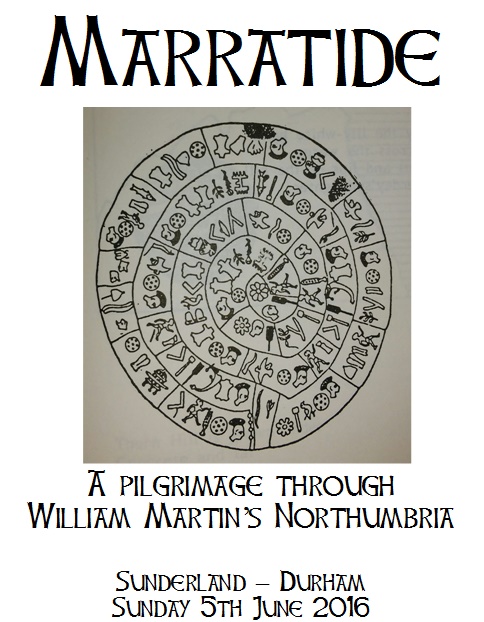
5th June 2016, myself and five other walkers set out on a pilgrimage of around
fifteen miles from Sunderland to Durham. Following in the footsteps of the late
poet, William (Bill) Martin, and his friend and fellow writer, Gordon Brown, Marratide saw the rekindling of the
flames of a walk which last burned to embers in 2008, two years before Martin’s
death.
I was
joined on the walk by a longstanding friend of Bill’s, the poet Peter Armstrong,
himself a regular on the walks since their inception in the early 1980s; his
partner, Christine; and friends, colleagues and fellow poets connected, if not
by birth then by residency and/or literary association to the North-East: Jason
Lytollis, Kris Johnson and John Challis.
The walk
begins at Tunstall Hills, around two and a half miles south of Sunderland city
centre. Significantly, Bill Martin was born and spent his childhood half a mile
to the south-west, in Silksworth, and resided for the majority of his adult
life in a house several hundred yards to the north of the hills, in the Tunstall/Ashbrooke
area. Bill’s son, Graham, whom I’ve been in touch with for around four months
now, agreed to meet us at the start of the walk, to give an overview of his
father’s work and the symbolism and connotations of the route and its
relationship to the poetry his Dad wrote.
Notions
of ‘The Return’ – a recurrent motif in both Bill’s life and literary
composition – were to be our starter and guiding principle. Graham spoke of how
his father’s work was concerned with spiritual elements of the return, but also
of wider environmental, social and divine connotations pertaining to the
cyclical nature of being and its emblematic representation in artworks.
Upon
request, I – we – were to carry a ram’s horn containing a small amount of Bill’s
ashes, to be spread in the river Wear near the racecourse at Durham — a site
doubly poignant for its being the last place Bill’s friend, Gordon, drew breath
before throwing himself into the river. We would depart from the ‘Maiden Paps’,
so-called for their representation in the landscape as the female Goddess,
evoking fertility and maternal guidance, and traverse a landscape imbued and
interpreted in myriad ways by the eyes of Bill Martin, a visionary poet,
pantheistic in his outlook, global in his concerns, but firmly rooted – not bound
by – the locale of the east Durham coalfields.
It is
incredibly humbling to be asked to carry the ashes of a man you’ve never met to
a site you’ve never been to, in absentia of family members. As Graham was
unable to take part in the walk, though, and as he mentioned in his opening, it
is perhaps fitting that a group, or troupe, of poets should be ordained with
the task of scattering the ashes of another poet. A kind of taking the baton,
lighting it, and passing it back to the place from whence it came: the river
banks, the water, and eventually the harbour mouth and open sea beyond.
Looking north-east towards Tunstall Hills, Sunderland, parallel to the A19
Graham,
quite understandably, was reluctant to recite any of his father’s poetry (“I
didn’t do the walks because of the poetry”, he told us, “I did them because it
was me Dad!”) but he did bid us farewell with a song, a verse from ‘Leafy
Lonnen’, taught to him by his father, and recounted on the hills in a manner
which can only be described as ‘hair-raisingly’. The refrain:
‘Up the leafy lonnen
with
windows green as grass
call
at my hinny’s door
she’s
a bonny lass.’
How a
walk can be a return when you’ve never done it before is something I
contemplated – am still contemplating – for much of the route. Most of the walk
follows former coal wagon ways, including the gravity railway line where, as a
child, Bill would play. The vital significance of coal mining on Bill’s sense
of identity and in his verse cannot be underplayed: born into a Methodist
mining community in 1925, he lived during what was probably the peak of carbon extraction
in this country, in a region which, even to this day, is still associated with
black diamonds more than perhaps any other on earth. To follow, from the place
he was born – an actual walled mining village in north-east Durham – the wagon ways
that carried those spoils of labour from their bedrock below the ground, out of
the parochial enclosure of the micro-local, on journeys towards commercial
exchange at the sea ports of Seaham or Sunderland, and/or the railway mainline
bisecting County Durham on its trajectory between London and Edinburgh, must
have been an incredibly profound experience for Bill.
Much of
Bill’s poetry is concerned with trying to situate his conception of the ‘Marradharma’
within pre-existing religious iconographies and creation myths. As a sort of
manifesto to his verse, it is worth dwelling on a quote from Bill as to the
mission of his work:
‘Poetry
should be concerned with more than personal, domestic and confessional themes.
Being [part of] creation, we are involved in the continuing search for a
collective sanctus... if we reject elitism and ego-economic notions, we
will find that ‘marradharma’ under our noses. Art is not a programme, neither
is a poem a tract, but it is surely rooted in dharma.’
So, it
follows that the ‘Mothergate’, (the main roadway in a pit), should have vaginal
connotations, evoking not only the fertility, birth and re-birth of the animal,
vegetable and mineral, but the cyclical endeavour of the whole — man, woman,
people, earth, spirit. In a world which, post-industrial as it now is, keenly
felt and realised especially in the North-East since Thatcher, such concepts
might seem gaudy or sentimental, but by considering Bill’s poems as we walked,
I got the impression that those in our midst who were too young, or simply
weren’t present, to appreciate the totality of a mining community mindset,
somehow instinctively felt that these things haven’t just ‘vanished’, as so many
commentators suggest; and that, maybe by cross-referring their vestiges (former
wagon ways turned to bike and foot paths) we may be able to see in this world
elements of former ones, and feel stronger, more bound together, for having
glimpsed such a vision of wholeness.
Wholeness
dovetails neatly into another aspect of the walk which Graham mentioned: common
feasting. Traditionally, before the walks began, Win – Bill’s wife – would prepare
breakfast, and the group would sit together in common feasting, to be fuelled
physically for the spiritual journey ahead. Graham laughed when he recalled
that, as the years passed, the lengths of these communal breakfasts also
increased, so that quite often the party wouldn’t be seen in Durham until dusk
was beginning to fall. Unfortunately for our group, no such communal breakfast
was to be had before we left. Instead, the image of groups of men sitting in The
William Jameson in Sunderland at quarter past nine that morning was the closest
we came to observing any kind of collective sanctity, though it is debatable
whether pints of lager on a Sunday morning in a Wetherspoons is actually
conducive to any greater, spiritual cause.
Copt Hill Inn, now
Copt Hill Inn, then
Superfluous
as it might feel to detail the precise itinerary of the route, it will be worth
ruminating on certain sections. The first significant point, after the
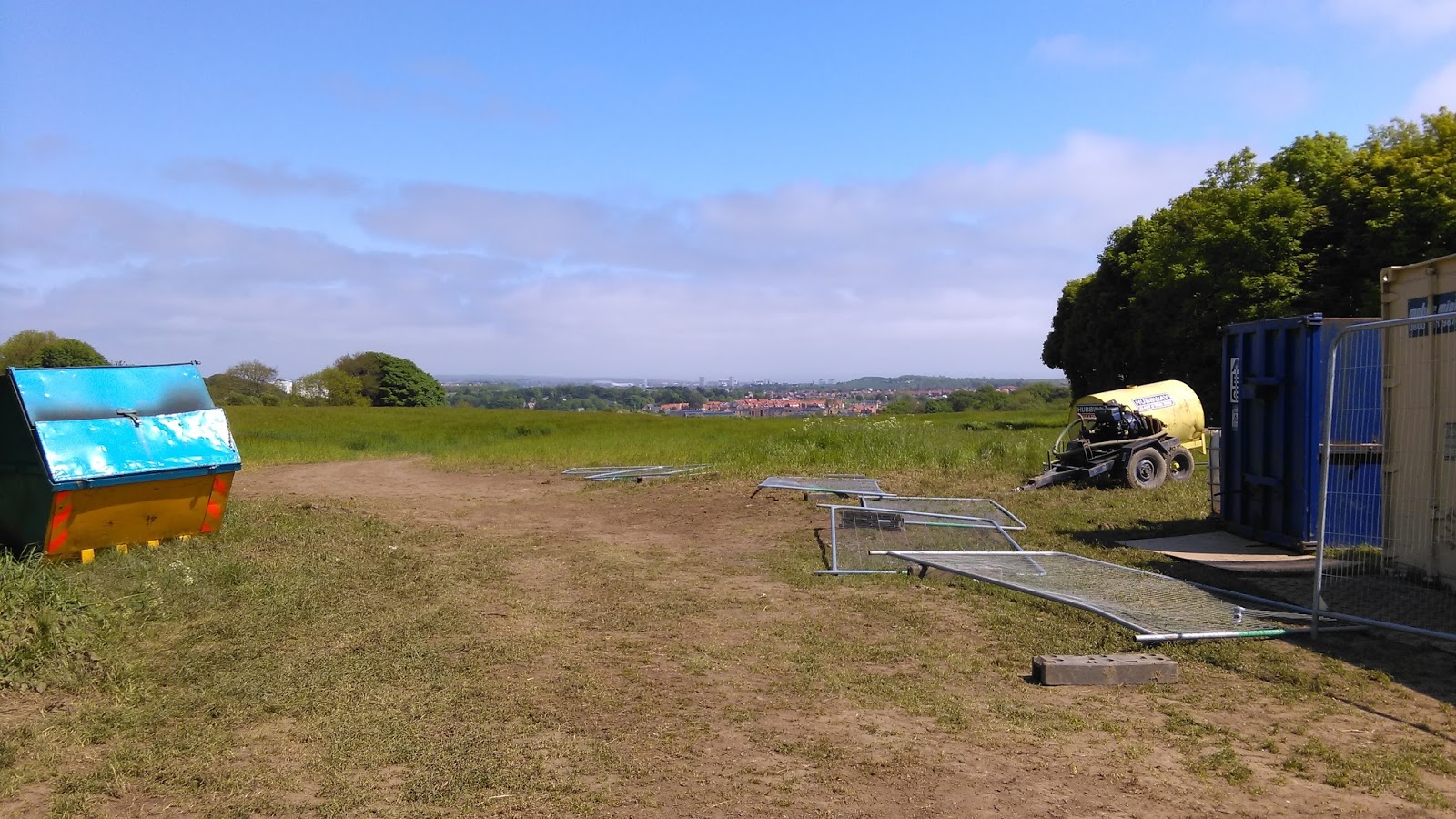
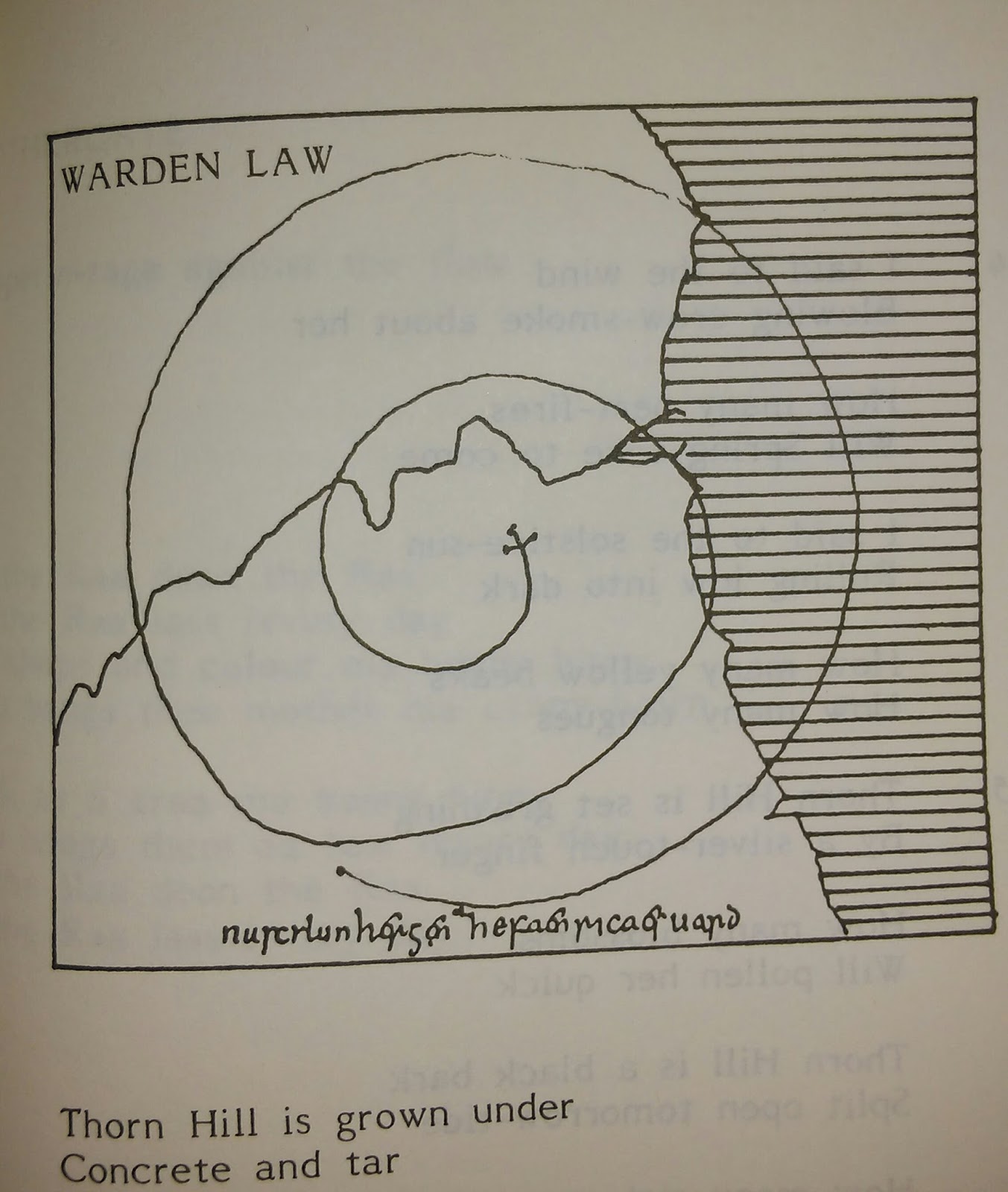
beginning, of course, was Warden Law, the highest point in east Durham, and our
first sense of the scale of the landscape and its effect on how Bill wrote his
poems. His ‘Wiramutha Helix’ sequence (Hinny
Beata, 1987) appears to place the reader in the position that we found
ourselves in, atop Warden Law, looking north. An image from the poem, below,
serves to extrapolate my point: that first Bill must have spent many hours –
years, even – carefully observant at and around this point before ‘joining the
dots’, as it were, and conducting an outwardly-spiralling helix to link the
physicality of a varied Wearside topography with associated mythical, spiritual
and industrial points. Personally, I
find this hugely inspirational as both a method and mode of contemplation and
creation: to bring the poem(s) forth almost literally from the landscape, and
sequence or (re)order them into a shape that engenders in a reader a totally
new conception of an otherwise everyday vista.
From 'Wiramutha Helix'
Next, and
a mere quarter of a mile after lunch at The Copt Hill Inn (many Sunday dinners
being served to conspicuously young families, a promising sign of the vitality
of the traditional pub) we reached a glorious view of the Seven Sisters round
barrow, thought to be a Neolithic monument. I counted six of the ‘sisters’,
suggesting that inclement weather, or a rogue woodsman, has at some point
felled one of them. My photo, below, is poor, taken as it was several hundred
feet from the site and zoomed in on a smart phone, but it nonetheless depicts
an image Bill Martin would have been drawn to for a variety of reasons.
Seven Sisters
Hetton
Bogs (much better looking than sounding) was the next section in which the
party felt particularly inspired. I’m always wary of the term ‘Nature Reserve’,
with all its ecocidal ramifications and anthropocentric delineation, but giving
them the benefit of the doubt, Sunderland City Council have certainly got
something to be proud of in the reed beds, butterflies and orchids of Hetton
Bogs. Peter recalled that a particular orchid, which he couldn’t remember the
name of, used to grow along this part of the route and was prized by Bill not
only for its beauty, but its links to spiritual and ecological iconography. We
certainly didn’t see it if it was present, but that might be a result of the
untrained eye. Ditto, a specific type of butterfly, which I have forgotten the name of, but which was also traditionally
found around the Houghton skirts of the route, was not witnessed, leading to
much discussion surrounding the alarming effects of climate change on natural
systems in a short spell of time.
From Low
Pittington and a stop outside the Blacksmith’s Arms, where shady dealings of
some sort appeared to be happening between five heavily tattooed blokes and the
boot of a Vauxhall Astra, several miles were spent within an otherwordly tunnel
of trees as we wound our way to the edges of Durham. Recalling a walk in the
80s, during the miners’ strike, Peter told us about how Bill and Gordon
witnessed at this point striking miners digging into the embankments, to carve
out whatever limited, poor quality spoils of coal remained. Always in
solidarity with the spiritual dimension of the miners and their plight, it is
important not to forget that Bill was politically motivated, too, and sympathetic
to their cause: the striving for fair pay and working conditions which always
found its point of focus, annually, at the Big Meeting in Durham where the walk
ends.
Blacksmith's Arms, Low Pittington
And on in
to Durham: arriving in Dragonville, via a subway beneath the A1 motorway, the
walk had gone, in a matter of metres, from a pleasant afternoon stroll
surrounded by cows, fields of Rape Seed and ancient Oaks, to an industrial estate
comprised of all of the industrial estate ubiquities: Carpet Right, Tesco,
Argos. At this point, I recall a conversation with John where we discussed Paul
Farley and Michael Symmons Roberts’s Edgelands,
and how and why places like this – at the periphery of the rural and the urban,
but not quite belonging to either – have become such rich sources from which
poets draw inspiration. Perhaps it’s the Gilesgate Moor Hotel sitting next to
the Solar Panel business; perhaps it’s the Aldi flanked by the curving fields;
or perhaps it’s because, paradoxically, these anywhere-places can actually be
comforting in their disquiet sense of repetition and replication that poets and
artists can stake claim to ‘their’ Tesco Extra, with only its view of the
spires of Durham Cathedral, or ‘their’ Screw Fix with its particular pile of
pallets and fly-tipped piles of junk at the corner of its car park.
Onward we
walked, knowing that this place had changed much and little since Bill last
strolled through it. Half a mile out of Pelaw Wood, we were greeted with our
first uninterrupted view of the Cathedral – a mighty prospect from any vantage
point, but one less familiar, seen here from the east, as opposed to the more
common view from the west, via the train line.
Found Poem?
Then, a blockade:
the path closed ahead. This was particularly annoying and upsetting as it meant
that the part of the river where we had been asked to scatter Bill’s ashes was
entirely inaccessible, as the council were doing salvage and reclamation work
on a landslide. Still, better to divert than be crushed by mud. As if appearing
like the ghost of Bill Martin, a man appeared from the bushes, having taken the
alternative route with his dog, to instruct us of the way round. I don’t
remember exactly what he said because I was listening to his accent: that
glorious Durham lilt, not quite Mackem, and not quite Geordie – something all
of its own, drawn from the earth of this hilly place – which said, “Just follee
the track”. Follee. Folly. Were we fools, to follee this path, or would we have
been fools to’ve trespassed through the gates and carried on as originally
intended?
Whatever
the case, the diversion was a good one, serendipitously affording a stunning
aspect of the cathedral. As we descended back down to the riverside, a tranquil
scene which seemed set to an eternal loop of ‘life is but a dream’, played
before our eyes, as rowers of various calibre and intention stroked the Wear;
as young couples frolicked with ice creams along the banks; and everyone else
either lay and sunbathed, or read, or just took in what felt like the first
real day of summer, whistling ‘Row, row, row your boat...’
Durham Cathedral, from Pelaw Wood
Our
penultimate stop (discounting the pub) was Durham Cathedral, where
traditionally pebbles and stones picked up en route were laid at Saint Cuthbert’s
tomb. Unfortunately, a group of Australian pilgrims had beaten us to it and
were preparing for the choral evensong, meaning we had to go with plan-B and
pay respects to another great Northumbrian: Saint Bede. For Bill, this aspect
of the walk was of paramount importance, as not only did the route trace former
industrial byways, it followed the procession of Cuthbert’s coffin as it was
carried, finally, from Chester-le-Street to Durham. The significance of the
offering of stones is mentioned in Bill’s poems, and their movement from site
to site has religious sanctity across a number of cultures and associated pilgrimages,
so it was, again, upsetting not to honour this aspect of the walk, but having
read and wrote about Bede so much in the past twelve months, it felt like an
honourable personal compromise to lay a stone, for and from Bill, to Cuthbert,
via Bede.
Emerging
from the Cathedral parallel to the south transept, which I’ve never done
before, back into crystalline blue skies and the cobbled streets of South
Bailey, knowing that we were entering the final stages of the pilgrimage, I felt
really quite moved. As we walked to Presbend’s Bridge, Peter gauged the wind
direction and speed. Unlike some of the bridges in Durham, this one is pretty
high, and because bridges by their very nature have to be durable, it is also
pretty thick. We ascertained the best side of it from which to make the
scattering (south), removed the gaffer tape and cotton wool Graham had sealed
the horn with, and thanked Bill and each other for accompanying us on the walk.
I strained to reach my arm to its full extent over the thickness of the bridge
wall, and tipped. At first the ashes whooshed east, back onto the bridge and
towards the river bank, but then the gust dropped, allowing them to fall more
or less vertically. In the seconds that passed, as they flowed from the ram’s
horn which Bill first picked up thirty-something years ago, somewhere along the
route we had just walked, a gentle breeze caught them in an updraft and they
widened and fanned out into thousands of tiny dots caught between the surface
of the eternally-flowing water and the glow of the early evening sun.
As all
good walks do, this one finished with a celebratory pint. We walked the final
metres along the banks of the Wear, Bill now at our side, to Framwellgate
Bridge, where we rejoined the throng of early evening diners, students making
their way to summer balls and shoppers kicked out of shops. The Head of Steam
was where we finished, pints of Durham ale and Ox flavoured crisps set before
us on the bench. Jason, unfortunately, had left by this point, but the
remaining five discussed Bill’s poetry. Peter and Christine, who knew him very
well and for a long time, talked about the bardic quality of Bill’s
performances, and how his poetry, as Graham had implied that morning, deserves
to be read by a much wider audience. As I went to leave, thanking everybody for
joining me, Peter said ‘Next Year in Jerusalem’, adding that it’s what Bill
always said at the end of his walks, because once you’ve seen Durham Cathedral
in mid-summer, the only other place that could compare might be Jerusalem.
Joanne Clement and I held the first ‘Haliwerfolc’ poetry event at Empty
Shop in Durham last Wednesday evening. The night was well attended, with around
25 guests turning out to see readings from Lisa Matthews, Padraig Regan,
Mandana M. Ghoyonloo, Paul Batchelor and myself and Jo.
We hope that this will be the first of many events in Durham and across
the region, sitting in tandem with well-established nights such as Colpitts and
readings organised by Durham University English students. Following on the back
of Jo and Tracy Gillman’s ‘The Cold Boat: Poetry of Witness’ – itself a follow-up
event to Carolyn Forché and Shami Chakrabarti’s recent human rights and poetry
discussion at Newcastle University – we intend for Haliwerfolc to become a
sustained conversation piece between literature, the North-East region and broader
socio-political and environmental topics that we might widely label ‘internationalism’.
Watch this space for details of our next event, coming very soon...
I was
honoured, delighted and surprised three weeks ago to be presented second prize
in the annual Basil Bunting Poetry Prize for my poem ‘‘Love’, not ‘Pet’(Saltney Melancholy)’. Judged by Don Share, of Poetry fame, it feels like a real feather in my cap.
Entries
in the children’s prize were particularly inspirational, and it was a real
moment of happiness to see a selection of the winners read their work in such a
professional and joyous manner. Don rightly nodded to their inclusion and
enthusiastic entries as being a positive testimony to the beginnings of a life
spent enjoying the riches of poetry.
Winners
in the children’s prize, as well as Elvire Roberts’s third place poem, can also
be read on the NCLA archive site, in the tab to the right of the page.
Isabel
Galleymore’s winning poem, ‘The Limpet & the Drill-Tongued Whelk’
rightfully took first prize in the main competition: it is a deceptively
compact poem which achieves the mean feat of taking two incredibly small
creatures and magnifying them, Big-Top-like, to the realms of carnival. It’s a
really incredible poem, I think, and more on Isabel’s work, including her
pamphlet, Dazzle Ship, can be found
online.
On Sunday 5th June 2016, I will set
off from Tunstall, Sunderland, the former home of the poet William Martin, and
walk to Durham Cathedral, arriving some six to eight hours later, via a route
of around fourteen miles.
I will be following as closely as I can a route
which William – Bill – and his friend, Gordon Brown, along with family, friends
and other artists, mapped out and walked each summer solstice, through the
historic landscapes of north-east Durham. Bill’s walk, in memory of the ‘Haliwerfolc’
– the people of Saint Cuthbert – was itself a palimpsestuous perambulation (or,
simply, a layered walk) in which he retraced the final journey of Cuthbert’s
coffin as it was carried from Lindisfarne and laid finally to rest in a tomb at
Durham Cathedral.
The route traces former railways lines of the
east Durham coalfield, including a gravity track which ran through Warden Law
down to significant coastal collieries and ports and docks at Wearmouth and
Seaham Harbour. It begins at Tunstall Hills, which Bill affectionately referred to
as the ‘Maiden Paps’ (evoking the Goddess, or the spirit of the land), and
continues through farmland, fields and hills, as well as suburban or semi-rural
villages, between Durham and Sunderland.
Walking through this part of the world, Bill
connected the beautiful natural landscape with its vestigial, industrial scars,
but he also sought to ensure that respect was paid in the contemporary world to
the people of the region: its working-class solidarity and traditions; its
healthy respect for the relationship between people and place; and its
continuing draw as a source of inspiration for poets, artists and musicians
who, if not born here, have made the region their home.
Bill’s own practice as a writer and artist drew
as much on worldwide traditions of spirituality, religiosity and artistic
connotation as it did on the micro-level of north-eastern folklore, street
games and songs. Because of this, his work, while firmly entrenched in the east
Durham landscapes which he inhabited, does not feel bound by it: instead, he is
rooted here, but has branches and tendrils of thought spanning out in multiple
directions. His poetry, as a result, is a rich tapestry of stimulation and
reworking; and it is in this celebratory vein of the local artist connected to
a global world that this walk will be undertaken.
If you wish to join me, please get in touch. A
full blog post, detailing the walk, will be made in the weeks after the event,
and if you can’t join this year, it is my intention for this walk to continue annually.