Friday, 26 February 2016

Moving Minds exhibition


My poem, ‘Forst’, appears as part of the Moving Minds exhibition at Oriel Sycharth gallery at Glyndŵr University, Wrexham.

From the official blurb, curated by Mike Corcoran, Moving Minds is, “an exploration of the mind and its relationship with the brain, body and world: through art, media and performance.”


I went down to have a look at the gallery yesterday, and it’s a real gem: packed full of surprising installation pieces, artefacts, photographs, poems, sculptures and other works which span or blur the boundaries between genres, forms and mediums. The most impressive thing about it, though, is how all the works hang together around that theme of the mind and its extensions into the physical realm. Top marks to Mike for curating such a thought-provoking and beautiful collection of artworks.


Moving Minds runs at Oriel Sycharth until the 15th April.


Tuesday, 23 February 2016

Newcastle Journal/Evening Chronicle Publication

My poem ‘A Museum Closes in the North’ is published in today’s Journal, and featured yesterday on the Newcastle Evening Chronicle’s website. There is a video of me reading the poem at St. Paul’s Church in Jarrow (the road opposite the closed Bede’s World was too noisy) and of course, the poem features at the bottom of the article, too.


I, like many others, were shocked at the closure of Bede’s World, and look forward to it reopening soon on firmer footing. Meanwhile, the final community heritage (or ‘outreach’, as the article would have it) event of the Stringing Bedes project will take place in March. Date and venue TBC, but I will post about it in due course, in the hope of drumming up as many guests as possible, as this project now seems more relevant than ever before.

Thursday, 18 February 2016

Review: a Niall Griffiths Duo


SPOILER ALERT!

Two books, one year apart, same settings: the mountains of west Wales, Aberystwyth, the small towns and hamlets that surround it. Grits and Sheepshagger read almost like the same book; or, more apt to the subject matter, Sheepshagger reads like an extended, hallucinogenic nightmare within the wider narrative of Grits.

Griffith’s debut, Grits, which appeared in 2000, was barely in paperback when Sheepshagger appeared a year later. Both novels follow the plight of a group of drifters and druggies; reprobates and really-couldn’t-give-less-of-a-fucks as they bounce from pub to rave, house party to hovel, beach to mountain shack. Where Grits, at just shy of 500 pages, traces a wide range of characters—Irishman Liam, Scouse Colm and Yorkshire lass Mairead being just three of them—Sheepshagger is really only concerned with Ianto, hill-dwelling hermit-come-couchsurfer, wreckhead-come-ferral mountain boy.

Just as Grits is interspersed with passages from the metafictional Guide To West Wales (anonymous authorship), referred to several times as being the life’s work of a crazy bloke who walked into the sea, Sheepshagger splits its narrative into thirds: the present continuous exploits of Ianto, wild, wicked and apparently uncaring in the hills; a stoned conversation between his former friends, Marc, Griff, Danny and Llŷr, each trying to explain Ianto’s descent into murderous rage while simultaneously absolving themselves of blame; and flashbacks to Ianto’s childhood, where we begin to piece together the tragic, weird and horrific events that might have shaped him into what he later becomes: a vicious murderer, himself ultimately murdered.

Where Grits is bleakly funny—laugh-out-loud so, at times—Sheepshagger is just bleak. What lifts Griffiths’s books above a study of depravity, however, is his ability to manipulate us and reconsider characters and their actions from more than one point of view. Roger, for instance—a heroin addict from South Wales who has drifted to Aberystwyth to smash bottles in the faces of students and whack pool cues round the knees of police informants—is a loathsome character in Grits, but in Sheepshagger, we see him act as the protective older brother to Ianto when most others couldn’t care less. In a particularly tender scene on the beach, coming down from ecstasy but going up on whisky, Roger joins in singing with pissed-up Ianto, ruffling his friend’s hair affectionately.

In Grits, the sense of omniscience that forces us to think of these people as more than just smackheads, is managed by a narrative divvying up: one character’s monologue may initially present them as likeable, but a later character may contradict what has previously been said, thought or done. We witness several scenes twice or more times, from differing perspectives. A nod to Bede’s sparrow at a rave in the hills is seen from two vantages, as one set of characters dance like wind-up toys and another set zone out to the varying chemicals and intoxicants in their bloodstreams.

Another good example is Colm: initially thought of as a happy-go-lucky, witty young man from Liverpool who always has a comeback or a wry, philosophical observation, he later becomes, well, a bit of a twat, and finally, a desperate and anonymous beggar, pitied by a former mate. Depending on who is narrating, we see different sides of characters; find out more about their dark pasts; what unique set of circumstances has brought them to each other, to the town at the end of the line, hotbed of hippies, vagabonds, crusties, punks, students and those who just want to disappear for a while, or forever.

And while in Grits (perhaps purposefully) this prolonged party, this drug-after-drug-after-vomit-after-vodka, never really leads anywhere, in Sheepshagger we are presented with a much more ‘packaged’ novel. We know from the outset that Ianto has committed several heinous acts, and we soon find out that they lead to his own death, but we don’t yet know why. That is not to suggest that the book is set up as a detective piece; far from it, but Sheepshagger is the more self-contained of these two novels: it achieves in under 300 pages what Grits doesn’t (though, as said above, it probably doesn’t intend to) in 500. I would say that that ‘thing’ is wholeness, or narrative resolution, but as the four lads note towards the end of Sheepshagger, Ianto still feels alive to them, his story unfinished.

Just as Malcolm appears to have ‘escaped’ Aberystwyth at the end of Grits, boarding a train for something new, the reverberations of enigmatic Ianto and his shocking acts of brutality live on beyond the closing pages of Sheepshagger, putting into question notions of a perfect narrative arc. In fact, it is apt that the latter book closes with the lads getting their coats on to go to the pub, to ‘get lashed’ and forget about Ianto and their part in his death. We know that they will end up in the same pubs that all of the characters frequent in both books, shooting up, drinking multiple concoctions of pints and spirits and generally wasting their lives.

Which would be the ultimate liberal’s way to end this review: to adopt a holier-than-thou stance and suggest that, as educated people, we are better than those grits in the machine, who shoot up, imbibe silly amounts of alcohol, or smoke and swallow preposterous amounts of brain-frying chemicals. But Griffiths’s books are smarter than that, and we as readers must react to them on many levels. If we detest Ianto as he viciously murders two innocent hikers taking in the spiritual energies of the abandoned mines of Wales, then we must also detest, or at the very least question the motives of, the English colonists who have bought his former childhood home and turned it into a private weekend retreat for their Hooray Henry mates from the home counties.


Just as we are right to detest the paedophile who brutally assaults ten-year-old Ianto, we are right to detest his supposed friends for egging him on to masturbate in front of the object of his affections, Gwenno. These books play with morality, morals and subjectivity. They never let us off the hook or allow us to swallow a simple truth. They are, ultimately, hymns to people in places—to the bays and the hills, the farmhouses and the farmhands—but they are hymns that recognise the complexities and contradictions of life and all its stark beauty and stark cruelty. In their masterful adoption of multiple vernaculars (Welsh, Scouse, Essex and more are all handled without any recourse to condescension); in their monumental evocations of space, place and time (in the mountains and waves that will outlive all); and in their attention-to-detail, their recurrent little vignettes and repeated character quirks and allusions, Griffiths’s books present a picture of a part of Britain quite unlike anything else I’ve ever read.

Monday, 18 January 2016

Palimpsests, Practice and PhD Research

Before I started my PhD, I attended a talk by Professor Elizabeth Mason-Whitehead, as part of a staff development session for the department of the University of Chester which I was at the time employed by. She talked candidly about why somebody might want to study at this level, and the various routes into and through doctoral research which might be available and how they could benefit staff already working, broadly, within Higher Education.

What I remember most clearly about her talk was her very personal journey: how she had gotten to the stage in her life where she was undertaking a PhD, and how that process played out within the rest of her professional life and in tandem with her personal life and other commitments. She talked a lot about the importance of a “space” – an office, a desk in a shared office, even utilising the kitchen table (not recommended) – for a researcher; a place you could call your own, make a mess of, leave books half read, post-it-notes lying scattered at will. Organised chaos, effectively.

What most stuck with me, though, was that she said a lot of people’s doctoral research – try as they might – cannot be separated from the rest of their life, their lives. It becomes a gigantic mish-mash of reading, work, family conversations, (mis)explanations, late night cups of tea and toast, scribbles, half memories, futile attempts at trying to relocate a source consulted two years ago.

So, in the spirit of not even attempting to disconnect the entangled spheres of my life, and because this blog has already alluded to my research, I have decided to write about my project here, most likely linking to it on my various social media feeds, as we all have half-lives online, don’t we, and I want mine to at least partially intersect with the stuff I do on a miserable Monday morning in January.


I calculate that I am now into the seventeenth week of my PhD. (Crucially, it is weeks, not months, because working around the academic calendar we always count in weeks). On Friday night last week (week 16, people), I triple saved my work to-date, backing up various drafts and scraps that constitute my ‘output’ so far. I have started 18 poems. Wow, you might be thinking, 18 poems in not as many weeks! Who are you, you crazy writing superhero?! That’s started 18 poems, not finished, printed, sent to journals, had acceptances, congratulated myself with a beer finished. Started. I have also started what can probably fairly be called a pre-draft of the first draft of what will become the introduction to the critical component of my project. For those not au fait with the composition of a Creative Writing PhD, 70% of my work will be an original creative project (in this case, a collection of poetry) with the remaining 30% being made up of a critical exegesis which is germane to the creative work. The view from here, I think it’s safe to say, is akin to perhaps seeing base camp through the mist, but not quite being close enough to contemplate any shut eye yet. To stretch the metaphor further, I’m barely off the runway at Lukla airport in Nepal.

One of the things that Prof. Mason-Whitehead didn’t touch upon in her talk last spring was the nature of what HEIs (Higher Education Institutions—oh yes, I still deploy all of those acronyms and abbreviations) expect of their PhD students beyond the niche of their projects: that they are, or quickly become, self-reflexive learners. For humanities students, particularly those whose work is practice-based (poets, musicians, artists), we pretty much do this stuff anyway. We reflect, we think about how we fucked up, and we resolve to continually evaluate our use of Oxford commas. For the Social Sciences students in our midst, though, this kind of practice might not be second nature. I stress the ‘might’ because I believe the binary opposition that can exist between the sciences and the arts is an unhelpful one, especially when cross-disciplinary (there’s a buzz word) working can be so fruitful. Alas, this is not a post about the science-art dichotomy, so I’ll leave that there, other than to say that blogs such as this – where a practice-based researcher critically examines his/her work to-date, with a view to improving in the future – is the type of thing my APR panel will no doubt like to see in another 16 or 17 weeks.

Here’s a photo of my desk. As you can see, it’s messy, but it’s been worse. I have a lot of stuff stuck to my wall: postcards; beer mats; maps; a good luck montage from my previous job; the mandatory splurge of post-it-notes; more beer mats... The desk is littered with the classic paraphernalia of the disorganised mind: a hole punch (?); an assortment of pens and stationery, acquired from a multitude of sources; a CAMRA Good Beer Guide from 2009, the year before my friend Alec moved to Canada and it therefore became superfluous to him; the packaging for my current phone, which, balanced atop the aforementioned GBG and a copy of A Little, ALOUD makes for a perfect impromptu base on which to raise my desk lamp (Argos’s second cheapest); a mug of tea (Rington’s, naturally); a diary; reams and reams of A4 print outs and unopened letters from My Waitrose and BT, most of which could and probably should have been recycled months ago... It goes on.

Portrait of the Artist's Desk as a Place of Order and Harmony


My friend Mike Corcoran is a big exponent of the extended mind hypothesis, which basically argues that we don’t just see objects and landscape features, we think through and with them; they form a fundamental part of how we engage and interact with the world around us. This theory is loosely tied into my PhD research, though at best tangentially (as I haven’t the time, necessity or jurisdiction to fully explore how, save creatively through my poems). I started the day doodling (another classic extended mind/cognition tool) and soon came up with a few Venn diagrams to remind myself of what I was doing, or supposed to be doing.

Then I came up with these two drawings, which I think illustrate my project quite well. They don’t contain any words (though their initial drafts did), because in a PhD project such as this, which is fundamentally all about words, it can sometimes be handy to think pictorially. After all, we see the world as a sequence of images: it is only after our brains have processed these images (into memories, opinions, strategies, etcetera) and we begin to reflect on them critically, that we as writers can begin to order, re-order, sequence, play with, distort and shape them to creative and/or critical ends.

Portrait of the Artist as a Tree Bisecting a Rainbow


The top image is supposed to represent, in quite a basic format, a palimpsest. One of the problems of PhD research (and, going back to the Prof, I remember her telling the room that it would continually be a source of some consternation to have to explain succinctly what your work was about) is putting things into digestible form, but doing so in a way that doesn’t undermine the importance of your own work and its complexities and significance. Put simply: you don’t want to patronise or confuse the person you’re trying to explain your PhD to, but you don’t want to sell yourself short, either. Hence, diagrams.

Palimpsest, at its most basic, means layers. A palimpsest is an (usually ancient) text, composed of vellum, on which prior inscriptions have been erased, or half-erased, and show up through and alongside newer ones. So, text from the initial markings on the vellum, erased so that subsequent texts could be imprinted, therefore extending the physical expiry date of the rare, expensive and precious material artefact, can in certain cases still be seen, or half or quarter seen. Texts of various chronology, history and sanctity can intermingle within one document. Sometimes, the meta-text can only be revealed by the use of infra-red or similarly technical light distortions and manipulations (as in the 10th Century Archimedes Palimpsest, in which X-Rays and ultraviolet were utilised in order for the ‘whole’ document to be read).

My project, whose long and intricate title bears repeating here – ‘The Swift Flight of a Sparrow: Poems Belonging to the Palimpsest of North-East England’ – argues that a palimpsest is both a metaphor and model which is useful for a creative practitioner to interrogate notions of identity and belonging. The physical topography of the land (the North-East) coupled with the shifting nexuses of personal memories, social histories and pre-existing literatures, constitutes a sort of three-dimensional palimpsest, with my poems being the ultraviolet light which distorts, magnifies or else reveals the various strands that exist and have existed on the same document.

Note the reverse: initial sketches half showing through. Choose to ignore or acknowledge the road and buildings in the background.


My final ‘output’ will be a collection of around 45 (depending on length) original poems which I hope will demonstrate that a sense of belonging to England’s North-East is based on its palimpsest makeup. This case will be defended via an accompanying critical paper of around 30-40,000 words, in which I will analyse a suite of North-East poets whose work I believe has employed similar strategies. All well and good. But for me, the later output, most likely a year or two after my PhD has been bound, submitted and hopefully awarded, will be the collection: those 40-odd poems, combined with perhaps 10 pre-existing ones, printed out and spread on to the floor, organised, moved around and toyed with, before being submitted to a publisher. Jumping ahead, the physical collection – a slim volume of perhaps 50-70 pages – will be the ultimate aim: a first full collection of poetry in which all of these theories and those years of research will be made manifest, to be enjoyed, deliberated and critiqued by readers and the wider poetry community.


From where I’m stood right now, I’m both glad and terrified that there is such a long, long slog ahead.

Wednesday, 9 December 2015

Writing Round The Mining Institute


I’ve been involved this year in Write Around The Toon, a student-led project which places PhD Creative Writing students at Newcastle University in cultural venues across Newcastle and Gateshead to undertake writing residencies. I first took part in the project in 2012, at the request of Viccy Adams, when I spent time at Bessie Surtees House on the Quayside. This time, as a full-fledged student, I asked the project organiser, Joanne Clement, if I could – along with Bernie McAloon – take up a residency at The North of England Institute of Mining and Mechanical Engineers, to give it its full title.

The Mining Institute (TMI) is an amazing building on Westgate Road, slap bang in the middle of Newcastle, 2 minutes walk from Central Station. Adjacent to, and effectively twinned with (though, there were ructions, I was cryptically told) the Lit and Phil next door, TMI is an example of Victorian splendour and a monument and memorial to industry not just in the North-East of England, but across the world. As well as being a repository and source of information for mining in times past, it continues to be used for contemporary studies into mining and offshore drilling, as well as various other engineering projects, and it is – to put it bluntly – an absolute joy of a place to behold. It’s a huge, huge shame, then, that relatively few people know about it.

My visit, in early November, was my first, and I very much had what Jennifer Hillyard, TMI’s librarian, described as the “wow” look on my face as I first stepped foot into Neville Hall. The view that greets the first-time visitor really is one to make the mouth drop agog. After coming in from a typically balmy Geordie day (read: hoyin’ it doon), and being welcomed with a cuppa tea, I quickly settled into my day of enquiry and writing. Jennifer showed me around the building, introducing me to the tracts, a store cupboard containing items of varying miscellany, gifted or donated to the Institution over the years, and of course to the lecture theatre with its magnificent semi-circular arrangement of seats overlooking the lectern and a wall of past presidents beaming out at you from their sepia frames.

Back in the main hall, sat with a fresh brew at the huge, communal table, I began ploughing through the tracts, amazed at the wealth of information and medley of mining-related literature they contained. Wrap your head around these ‘Questions For Mining Students’, below, as an example of just one of the wonders to be found. Even the ‘Elementary Stage’ baffles me: “Q1.—How is the ore-bearing character of lodes affected by variations in the nature of rocks forming the wall? Give some examples.”


It didn’t take long before I began writing, fairly aimlessly at first, into my notebook. Having spent the morning talking with a variety of characters – the cleaner, who greeted me; Jennifer, the librarian; two volunteers who were painting the doors downstairs; Simon, the secretary; and a BSc student from Sunderland University, doing his dissertation on Northern coalfields, and being ably assisted by the cavernous knowledge of one of the Institute’s members – it quickly became apparent that TMI is a place bound together by its community and acts as a space, literally and figuratively, in which to think, ponder, research, study, perform (a local circus act were rehearsing for a performance while I was there) and, if you like, simply be.
Coming in from the wind-whipped street and settling down to work for the day in TMI, I felt incredibly fortunate. Not only to be in such a space, of solitude and learning, of indebtedness to an aspect of the past of this place I come from, but a space which simply values people sitting and getting on with their own silent acts of study, repair, research or collaboration.
Having been shown an assortment of Davy and Geordie Lamps, donated to the Institute, I soon began to think about the Miner’s Lamp which belonged to my Great Grandfather and which still has pride of place on the windowsill in my Grandparent’s house in South Shields. Much of my PhD research is concerned with representing the past in the present – a process of ‘palimpsest poetics’ which features in my thesis title – and it was only a matter of time before I had to embrace, as far as the North-East is concerned, one of the Elephants in the room of that past.
Seamus Heaney, in Finders Keepers, discussing the work of Geoffrey Hill in a chapter called ‘Englands of the Mind’, says that:
“Hill’s celebration of Mercia has a double-focus: one a child’s-eye view, close to the common earth, the hoard of history, and the other the historian’s and scholar’s eye, inquisitive of meaning, bringing time past to bear on time present and vice versa.”
The poem I ended up writing, ‘Forst’, hopes to achieve Heaney’s multiplicity of time, bearing – simultaneously, perhaps – onto the past and the present. I use two Geordie dialect words – ‘forst’ (first) and ‘marras’ (mates/equals) – in combination with a more standardised English language structure. Readers, or listeners, of my poem will note that the dialect, combined with non-dialect words and phrases, often in complex patterns of consonance, make it a tough thing to read or listen to. Without going into a detailed assessment of my use of stressed or unstressed syllables and rhyme schemes or their lack, I will just say that the inconsistency in dialect throughout the poem is something that I have been quizzed about. But this is how we talk (taa’k), isn’t it? I’m proud to still call myself (caall mesel) a Geordie, or a Sanddancer, but I realise that I (aa) don’t speak the way my Great Grandfather would have done, his life spent beneath the earth in South Tyneside, with his marras, hewers and putters. I’ve never been down a pit (unless you count the replica drift mine at Beamish), and here I am doing a PhD in Creative Writing, for God’s sake. Nicholas Moore, me Great Granfathaa, could never have dreamt of such an existence!

So, the poem is an ode, of sorts, to the past: an acknowledgement of where I’ve come from and how the working lives and their associated traditions (the New Year ritual of first footing didn’t, as far as I can ascertain, reach any further south than County Durham) of the people in this area that birthed me have come to bear on the reality of my present. Which is what I think The Mining Institute does: it serves as a time capsule, in a way, chronicling the documents, maps, diaries and logs of mines and miners, yes, but it also functions in the present day as a place for learning to continue to flourish. A living genealogy.

Joanne kindly made a recording of me reading ‘Forst’, which will be up on the Write Around The Toon website soon. Sadly, I was unable to be filmed in situ within the venue, though Bernie was, and you should take a deeks (have a look) at her film, which explains her own research into the effect of mining in parts of County Durham on the lives of its women. Additionally, why not make a visit to TMI yourself? You never know what you might find, beneath that great statue of the Institute’s founder, Nicholas Wood.

Tuesday, 17 November 2015

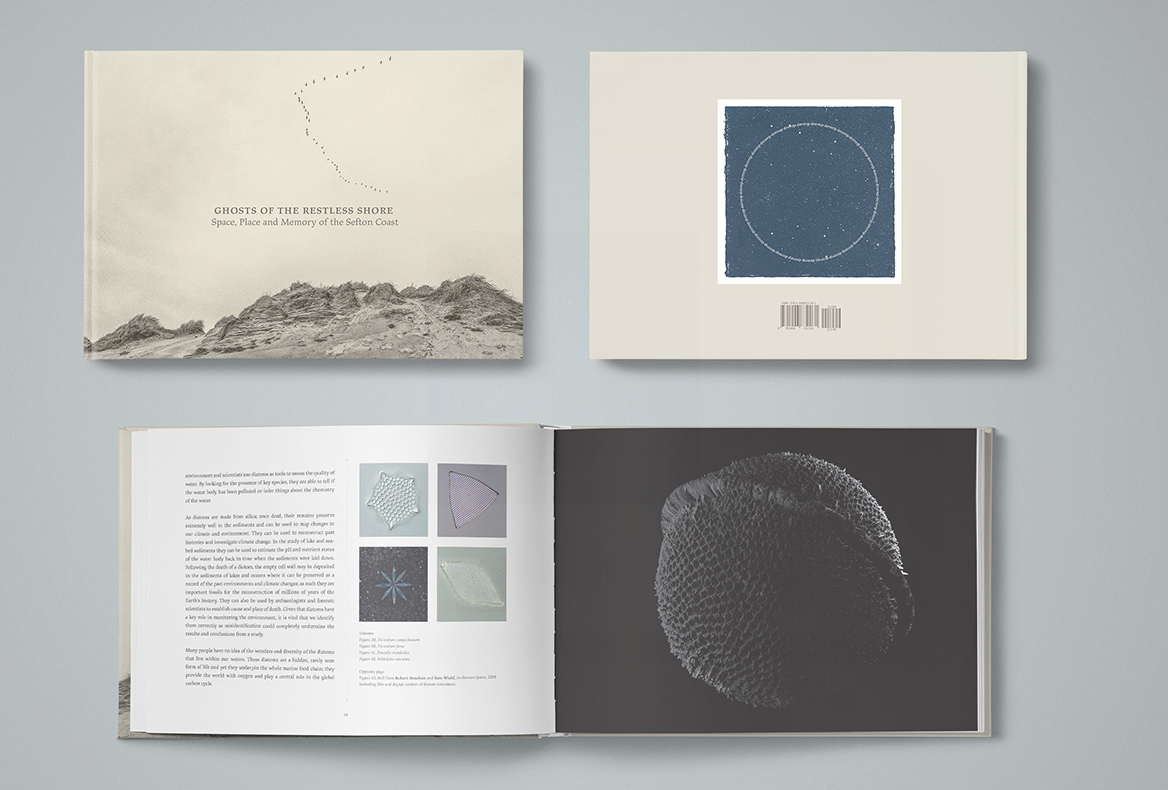
Ghosts of the Restless Shore

Ghosts of the Restless Shore now has a website and a beautiful, bespoke book cataloguing all of the artists' work.

(c)Tim Collier

For those who don't know, Ghosts of the Restless Shore, previously operating under the working title, Walking Through the Sands of Time, was a multidisciplinary art project I worked on, in 2014/15, alongside Mike and Tim Collier, Rob Strachan, Sam Wiehl, Geraldine Reid, John Dempsey and Stephen Whitle. Ghosts, whose genesis was in four days of public walks last summer along the Sefton Coast, from north Liverpool to Southport, is the umbrella project, if you like, for my own, recent pamphlet, The Coast Will Wait Behind You.

As the website details, and as the recent exhibition at The Atkinson Gallery in Southport showed, Ghosts was, as its full title suggests, a collaborative interrogation into the 'space, place and memory' of this particular stretch of North-West coast. It was a hugely rich and rewarding endeavour to be a part of, not least because I produced what I feel is some of my strongest work to-date, but also because it was a brilliant opportunity to be immersed in one of England's most remarkable coastlines: a place brimming with natural and social history; with shifting sands and hidden curiosities in abundance.

Do, if you feel inclined, seek out a copy of the book and my pamphlet: I'm sure it will inspire you, too, to walk the restless shore and investigate its charms and mysteries.

Friday, 30 October 2015

Botanic and brews: the Poets of Belfast

I’d like to talk a little bit about my PhD research, and quite a lot about Belfast, which I visited for the first time this week. I hope not to sound too solipsistic.

There is a strong and inclusive poetry community in this city, which stretches back a long time, through poets such as Louis MacNeice, Seamus Heaney and Paul Muldoon, to newer names, such as Sinéad Morrissey and Leontia Flynn, and to those newer-still, such as my hosts/drinking buddies/suppliers of fine, Northern Irish hospitality: Stephen Connolly, Manuela Moser, Padraig Regan and Tara McEvoy.


Queen's University

 I apologise that the “older” of those names were supplied rather arbitrarily. I do not mean to offend, but it really would be specious to reel off every Northern Irish poet I could. The latter four – Stephen, Manuela, Padraig and Tara – were part of the reason I was in Belfast in the first place: for the first Northern Bridge conference of the academic year. (Actually, Stephen technically wasn’t, though he’s also doing his PhD at the Heaney Centre, so it’s fine).

Northern Bridge, as some of you will know, is a Doctoral Training consortium and partnership between Queen’s, Newcastle and Durham Universities. They are very kindly funding me for the next three years to undertake my own PhD, with big get-togethers at the partner institutions being ideal opportunities to network/drink dandelion wine into the small hours.

Upon arriving in Belfast, and thanks to the wonders of social media, I received tweets from both Padraig and Stephen, first welcoming me to their city, then subtly suggesting that I might want to knock the official conference dinner on the head and attend a poetry open-mic instead. Cue apology to the Northern Bridge directors: I’m sure your Italian was gorgeous, and I appreciate the offer, but listening to poems and reading my own to a sympathetic audience is me networking, honestly.

Jo Clement reading at Bookfinders. 60 people in this room, 50 turned away at the door. Incredible.

 I met Stephen, Tara and Padraig in the Woodworkers on Tuesday night (Aye, I was that man who had to go up to each table and ask “do you know Stephen Connolly?”) Handily, on my second request, Tara told me he was just at the bar and would be back soon. The Woodworkers is basically to Belfast what Lady Grey’s is to Newcastle: one of the new breed of craft beer bars which have popped up across all UK cities in the past few years, but one in which honest conversation – and not pretentious wankers quaffing ten pound bottles of Mikkeller – still dominates.

Fast-forward to Wednesday night, conference meal skipped (after the free wine reception, obviously) and a short walk to Bookfinders. Padraig, Tara and I had had coffee with owner, Mary Denver, earlier that afternoon. Taking up Stephen’s plea to seek out Muldoon’s Selected, I asked Mary if there might be a copy lurking amid her shelves and pile of boxes. “I know I have one somewhere, Jake, I’ve definitely seen it recently.” She promised to dig it out, and, true to her word, it was waiting for me on the counter at 11am the next day. Five pounds, with a Club biscuit and a cup of tea.

A gem of a place.

For thirty one years, Mary has been proprietor of Bookfinders, but it is probably safe to use the oft-deployed (and, hence, weakened) term and call her a living legend. Queen’s English Society have been running open-mics in the back room of her shop for years now. Everyone has been through: Michael Longley and Ciaran Carson locally; Hannah Lowe not-so-locally. If the walls of Bookfinders could talk (and, in a way, they do, with their framed images of famous writers), they’d tell of lost evenings and candle-lit readings. Poets incanting poets; wine being spilled and slugged.

As is to be expected with a combination of a hangover, four hour’s sleep and being made to converse about your own research after a fairly dire continental breakfast with a load of archaeologists, my enthusiasm to discuss ‘space, place and landscape’ at 11am was about as strong as my desire to eat my own fist. Apologies to all the NB archaeologists, but discussing the poets who’ve graced the packed nights of Bookfinders was much more up my avenue.

I gave Mary a copy of my new pamphlet, thanked her for her kindness, payed for Muldoon, and headed back to the conference and to what turned out to be a stunning talk by Professor Richard Clay, on re-coding space. *Tangent claxon* Mixing Thomas Spence’s radical messages carved into coins with the street art chicanery of Sowat and Lek’s Paris mausolée – a mass street art exhibition in a disused supermarket originally squatted by a group of Romani people – Clay told us how graffiti artists, radicals and self-styled street artists reconfigure public space and attitudes towards ownership and hierarchy (now, via social media) in often tiny, but sometimes large, acts of space re-coding, which is not vandalism, he asserts.

Boundary Brewing: re-coding beer.

 After that, I was full: brain a heavy sponge, hangover in full-swing, belly grumbling from low-grade croissant consumed four hours earlier. So, Jo Clement and I retreated to Belfast’s other great book shop: No Alibis, which – as the name implies – is a crime fiction specialist, but should be better imagined as a safe haven for book readers and thinkers of all credence, age and background. I picked up one, two, then three books (would I have stopped? No, but my bag was already full to bursting, and I had a flight to catch), approached the counter, whereupon I spotted a signed poster by Boundary Brewery.

“Is that a Belfast-based workers co-operative craft brewery?” I enquired, placing my to-be-purchased pile on the bench.

“Yes, it is. Are you getting these?”

“Aye, please.”

“Well, I’m going to make your day!”

David then handed me and Jo a bottle each of Boundary’s IPA, which we dutifully supped while he showed us some of his more beautiful tomes; for instance, Michael Longley’s Sea Asters, complete with pen and ink illustrations by his daughter, Sarah. Beautiful as the book was, £110 on the card would have been – I don’t want to say ‘something I’d come to regret’ – but perhaps slightly unnecessary.

JC, JC, David.

 David’s wife/business partner, Claudia, also showed Jo a limited-edition they’d published by a crime writer, complete with its own set of bespoke engravings. Jo being a Bewick enthusiast, the delight on her face was evident. She was then diligently aided in searching for poetry collections incorporating engravings (ones that didn’t cost three-figures) while children and their families browsed around us and 80-year-old men brought in orders and women asked if they could advertise for their local markets.

I wanted to end with a quote: some perfectly suitable line from one of the names I mentioned at the start, but the truth is I don’t know one. My knowledge of Irish Literature, being an Englishman (though, wey, I’d say Geordie), is akin to Patrick Cotter’s thoughts in his introduction to the Young Irish Poets edition of Poetry Magazine (September 2015): “The Irish know more about Britain than the British know about Ireland, and Irish speakers in Ireland know more about the world of their monoglot Anglophone compatriots than the latter do about the discourse taking place in the minority Irish-speaking networks and communities.”


Though I only half agree with this statement (for the whole Geordie issue alluded to above, though for which I will, on this occasion, spare the reader from) I wanted to use it because while I think it is half wrong, it is definitely also half right: there is a very strong and very rich community of poets here. Manuela and Stephen, who run The Lifeboat series of readings, and who are branching further into pamphlet production next year, are just one example of many; Mary’s Bookfinders and No Alibis being two more. There is a sense, I think, that Belfast takes its poetry seriously. Not like it’s a duty, but something similar, civic pride, perhaps. In any case, it is both heartening to witness and a joy to behold. I look forward to getting more involved with it the next time I’m in the city, which I expect will be soon.

Poetry.