I was
honoured, delighted and surprised three weeks ago to be presented second prize
in the annual Basil Bunting Poetry Prize for my poem ‘‘Love’, not ‘Pet’(Saltney Melancholy)’. Judged by Don Share, of Poetry fame, it feels like a real feather in my cap.
Entries
in the children’s prize were particularly inspirational, and it was a real
moment of happiness to see a selection of the winners read their work in such a
professional and joyous manner. Don rightly nodded to their inclusion and
enthusiastic entries as being a positive testimony to the beginnings of a life
spent enjoying the riches of poetry.
Winners
in the children’s prize, as well as Elvire Roberts’s third place poem, can also
be read on the NCLA archive site, in the tab to the right of the page.
Isabel
Galleymore’s winning poem, ‘The Limpet & the Drill-Tongued Whelk’
rightfully took first prize in the main competition: it is a deceptively
compact poem which achieves the mean feat of taking two incredibly small
creatures and magnifying them, Big-Top-like, to the realms of carnival. It’s a
really incredible poem, I think, and more on Isabel’s work, including her
pamphlet, Dazzle Ship, can be found
online.
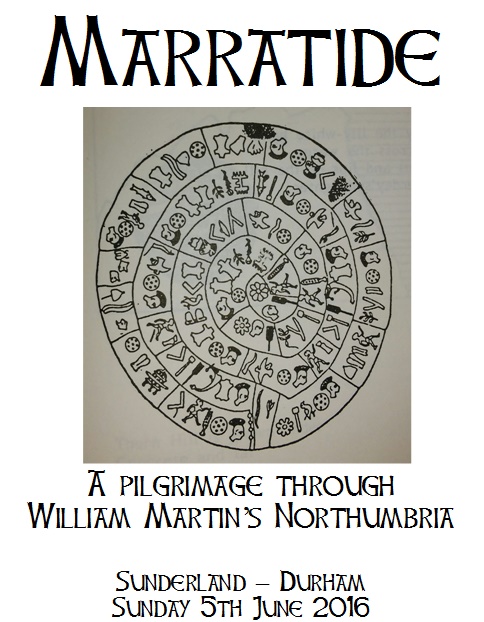
On Sunday 5th June 2016, I will set
off from Tunstall, Sunderland, the former home of the poet William Martin, and
walk to Durham Cathedral, arriving some six to eight hours later, via a route
of around fourteen miles.
I will be following as closely as I can a route
which William – Bill – and his friend, Gordon Brown, along with family, friends
and other artists, mapped out and walked each summer solstice, through the
historic landscapes of north-east Durham. Bill’s walk, in memory of the ‘Haliwerfolc’
– the people of Saint Cuthbert – was itself a palimpsestuous perambulation (or,
simply, a layered walk) in which he retraced the final journey of Cuthbert’s
coffin as it was carried from Lindisfarne and laid finally to rest in a tomb at
Durham Cathedral.
The route traces former railways lines of the
east Durham coalfield, including a gravity track which ran through Warden Law
down to significant coastal collieries and ports and docks at Wearmouth and
Seaham Harbour. It begins at Tunstall Hills, which Bill affectionately referred to
as the ‘Maiden Paps’ (evoking the Goddess, or the spirit of the land), and
continues through farmland, fields and hills, as well as suburban or semi-rural
villages, between Durham and Sunderland.
Walking through this part of the world, Bill
connected the beautiful natural landscape with its vestigial, industrial scars,
but he also sought to ensure that respect was paid in the contemporary world to
the people of the region: its working-class solidarity and traditions; its
healthy respect for the relationship between people and place; and its
continuing draw as a source of inspiration for poets, artists and musicians
who, if not born here, have made the region their home.
Bill’s own practice as a writer and artist drew
as much on worldwide traditions of spirituality, religiosity and artistic
connotation as it did on the micro-level of north-eastern folklore, street
games and songs. Because of this, his work, while firmly entrenched in the east
Durham landscapes which he inhabited, does not feel bound by it: instead, he is
rooted here, but has branches and tendrils of thought spanning out in multiple
directions. His poetry, as a result, is a rich tapestry of stimulation and
reworking; and it is in this celebratory vein of the local artist connected to
a global world that this walk will be undertaken.
If you wish to join me, please get in touch. A
full blog post, detailing the walk, will be made in the weeks after the event,
and if you can’t join this year, it is my intention for this walk to continue annually.
May is
set to be a good month for poetry. The second Newcastle Poetry Festival takes
place from the 5th to the 7th of the month, but before I
detail that, I’d like to draw your attention to a reading I’m doing at The
Poetry Lounge at the Sitting Room in Ludlow, Shropshire, on the 3rd
May.
Organised
by the poet Jean Atkin, and hosted within The Blue Boar pub in Ludlow, a market
town famed for its gastronomic delights and its location close to the Welsh
border, at the foot of the south Shropshire Hills, it’s set to be a great
night. Claire Leavey and poets from the floor will also read. I’m very much
looking forward to it. I haven’t been poeting (which is like Bunburying, but
more rhythmical) in Shropshire since I took part in Christopher Reid and Clare
Pollard’s Arvon course at The Hurst way
back in August 2011.
Then, the
main event: the Newcastle Poetry Festival 2016. I missed the inaugural festival
last year, as I was at the time still working at the University of Chester,
though I heard from a number of sources that it was an altogether excellent
thing. This year’s looks just as good, and of course I’m biased and have vested
interests, but we live by a mantra in the North-East which goes “Shy bairns get
nowt”, so I’m not going to be meek about telling you how great it all looks and
giving you the low down on my involvement in it.
Kicking
off with ‘Northern Landscapes: Picture Poems’, which has seen PhD students in
Creative Writing and Fine Art teamed up to collaborate and respond to the
transformational poem, Briggflatts by
Basil Bunting, Northern Landscapes will take over the Ex Libris Gallery for a
few days, presenting new visual, literary and hybrid works which in some way
take inspiration from, or react to, the fiftieth anniversary of the publication
of Bunting’s poem. My own new poem, ‘Each Pebble Its Part’ will feature, and I’ll
be reading it at a launch event on Thursday afternoon.
On Friday
the 6th, having been shortlisted for the Basil Bunting Prize, I will be in the audience as Don
Share, editor of Poetry magazine
(Chicago), announces the winning poems. I will then be flitting between a
bewildering array of events, ranging from an AHRC panel discussion on ‘Poetry and Urban Regeneration’, in which Bill Herbert will discuss his involvement in a
public arts commission in Darlington; a discussion between Don Share and
Stephen Burt on the legacy of Bunting; and readings by, amongst others, Fleur
Adcock, Mark Waldron and Sarah Howe. I will then go to the pub and try not to
drink too much before the Saturday...
...When
the seventh issue of Butcher’s Dog,
which I’ve co-edited alongside Pippa Little and Andrew Sclater,
will launch, alongside readings by some fantastic Red Squirrels, Vane Women,
and the always-brilliant Christy Ducker, who’s recently been resident poet with
the Northumbria Police Crime Commissioner, Vera Baird. The rest of the day will
be spent listening to poems by the likes of Kayo Chingonyi, Carolyn Forché,
Catriona O’Reilly and Matthew Dickman. Put simply: it’s a jam-packed line-up
that any poet within travelling distance of Newcastle ought to do their best to
attend. It’s also very good value, with a full weekend pass setting you back
only £20.
Once the Poetry Festival has wound up, I will be doing my first Annual Progress Review for my PhD and thinking about sending out to some journals again. Finally,
and hopefully not entirely poeted-out (or, out-poeted) by this stage, I will be spending the end
of the month in Northumberland, celebrating my birthday and putting my feet up at Seahouses.
It’s a
few days before Christmas, 2015. I’m stood at the bar in Independent,
Sunderland, ordering cans of Red Stripe for myself and Matt, one of my best
mates. We’re about to watch The Lake Poets, aka Martin Longstaff,
Sunderland-born singer-songwriter and purveyor of, in my opinion, some of the
best music to come out of the North-East in ages.
Martin is
about our age (late twenties), and many of his songs are, I think it’s fair to
say, bleak. I’ve seen him live a few times, and he doesn’t hide away from the
starkness of his material. Listening to his album – which you should purchase
immediately – is testament to this: it’s full of wistful tales of former
industry, failed romance and even child abuse. The type of stuff my Dad likes
to refer to as ‘hanging music’.
Not all of
it is pessimistic, though, and it is on his song, ‘Shipyards’, that I think
Longstaff is most adept at balancing nostalgia with rationality, showing that a
string of genealogy is necessarily fraught with tensions good and bad.
Before
this post begins to sound like a review of that gig or album, I would like to
introduce another ‘Shipyards’ song. The melodic punk band from Sunderland, Leatherface,
released The Last in 1994. On it, the
song ‘Shipyards’ opens thus:
‘And throw the fishermen lines
Close the shipyards and mines
Leaving the water, we still have the
old wives’ tales
About the old days, deep lonely
water, the old days.’
When, in
that crowded upstairs room in Independent a few days before Christmas last
year, The Lake Poets strummed the opening chords to ‘Shipyards’, I instantly
felt myself welling up. Before he’d even reached the refrain, I was gone,
properly sobbing into a can of mass-produced lager and a Kleenex that some kind
woman had offered me. “’ere you gan, pet. I’m going to sound like your Mam, but
it’s probably best you make that one your last”, she said, gesticulating to the
(aptly-coloured) red and white ‘Jamaican’ beer in my hand.
The Lake
Poets’s ‘Shipyards’ opens like this:
‘On the river where they used to
build the boats
By the harbour wall, the place you
loved the most
I
can see you there alone, but oh, you know, I’ll be there.’
An elegy
for Longstaff’s grandfather, the song reaches its refrain, ‘And if you could
see me now/I hope that I’m making you proud’, linking present back to past. It
is a song rooted on Wearside, a place that once built more ships than anywhere
on earth, and which we still think of as the archetypal Northern ex-industrial
town blighted by Thatcher, ignored by Blair and probably not even identifiable
on a map by most of the current cabinet.
Both
songs’ structures are classical in their efforts to tug at the heartstrings.
Unlike much of the raw, energetic, razor-wire punk that Leatherface are famed
for, their ‘Shipyards’ is a piano ballad whose keys are perfectly poised
against that oft-quoted quality of Frankie Stubbs’s vocals: his rough, barroom
poetry. Longstaff, in contrast, goes for the jugular with an appeal to
sentimentality: all acoustic guitars, falsetto range in the right places, with
that haunting refrain, ‘Proud, pro-ow-oww-d’.
Pride is
a good place to start from when thinking about these songs, and it necessarily
invokes the heavy industry that Sunderland and the wider North-East region used
to be famed for. But it can’t just be these songs’ sentimentality or nostalgia –
their expert evocation of a more golden era and time of plenty – that can make
a grown man break down in tears upon listening to them. In the case of the
Independent gig, the multiple pints consumed before even arriving at the venue,
coupled with the general mushiness of the festive season, was at least part of
the reason why I was so emotional, but The Lake Poets are comprised of a singer
and ensemble of musicians between their mid twenties and mid thirties. None of
them built a ship or worked down a mine, and neither did I. It’s true that
Frankie Stubbs, Dickie Hammond and the other members of Leatherface were
starting out as a band at the height of Thatcherism, and that they likely knew
many people who did work in those industries, but I still find myself puzzled
as to why, listening to them twenty or so years after they were written, in an
era that, in many ways, is vastly different to the one they sing about, I feel
very connected to the period they stem from and the response to it their music
evokes.
***
My PhD
research takes as its starting point a belief that I belong to the abstract
concept of the North-East of England because it is a palimpsest: an
ever-changing manuscript of layers, on to which many things have been written
and re-written. One of the things that I have found incredibly difficult to
explain (possibly because there are singers out there who have already done a
cracking job of it) is how I can
possibly feel connected to the former industrialism of the North-East, and even
why I should.
In
essence, we are speaking of vestigial nostalgia: a kind of hauntology in which,
the more we know about what life was like before, the harder it becomes to
reconcile that with what exists, or doesn’t exist, now. Sunderland was clearly
always a tough place to live, with not only the harshness that comes with
working on a river at the mouth of the North Sea, or deep underground in a pit,
but the disease and filth of the slums in the east-end, where workers were
crammed in to service those industries. No, it should not be glamorised, and it
is risky to romanticise the ‘brighter’ side of working-class life: the camaraderie
and the community, the jobs for life, the sense of work being a thing that
produced things and was servicing a national good. All of those things came at
a price, as history has shown.
***
When I
was sixteen, seventeen and eighteen, getting the bus to and from sixth form in
Ashbrooke, Sunderland, I would sit with massive headphones clamped around my
ears listening to mp3 records of American punk bands. There’d be the occasional
British band on there – mainly ska-punk stuff from the excellent Household
Names Records roster: Capdown, Lightyear, Captain Everything etc. – but in the
main it was the big Southern California and East Coast American sounds: NOFX,
Strung Out, Rise Against and a load of other bands on labels like Fat Wreck
Chords and Epitaph.
The
musical zeitgeist of 2004-2006 favoured nu-wave indie, or whatever moniker the
(at the time still just-legitimate, not free, glorified Topshop advert)NME shoehorned it into. Radio One was
full of bands like Arctic Monkeys, Razorlight and Franz Ferdinand, none of whom
appealed to me, and in the North-East, I wasn’t queuing up to watch The
Futureheads or Maxïmo Park in the way that many of the lads at college were,
but instead trying to pass for being of legal drinking age to enter clubs in
Newcastle to go crazy to the likes of Flogging Molly, or watch homespun hardcore
punks The Mercury League do warm-up sets to fifteen people in the shit little
room above Pure bar.
Then I
left the North-East and moved nearly two hundred miles away to Chester, to
study English and Creative Writing. I gradually replaced the punk bands with
new indie bands and other, less intense rock acts, until I was spending less
time at gigs and more time reading poetry anthologies. It was only much later,
applying for my PhD really, that I realised that the North-East, just as it had
produced some fine poets, had also produced some music I could relate to.
Despite
hating them first time around, I’d be lying if I said I didn’t get into The
Futureheads later. Seeing them in 2012, when they were touting their a’capella
album, Rant, at their own Split
Festival, I remember a tent of around 2,000 pissed people in Ashbrooke cricket
club singing along to the folk song, ‘The Old Dun Cow’:
‘Somebody shouted MacIntyre! –
MACINTYRE! –
And we all got blue-blind paralytic
drunk
When the Old Dun Cow caught fire.’
I also
remember lots of pies, Maxim ale, a Richard Dawson set, a(nother) Lake Poets
set, more Maxim ale, one or two Field Music songs, and leaving for the pub when
it transpired that headliners Public Image Limited were little more than a
front for John Lydon’s ego. It was all very stereotypically Northern, and of
course, I loved it.
***
Leatherface
came recently. Very recently, in fact, after one of those serendipitous Twitter
conversations the medium orchestrates so well, with the writer and publisher of
Influx Press, Gary Budden. I was peripherally aware of the death of guitarist,
Dickie Hammond, last year, and I do remember that Hot Water Music, whose
singer, Chuck Ragan, I have seen live, once did a split with them, but they
were never ‘on my radar’, as it were. Which is a massive shame. Ten-twelve years
ago, as I was sat on the 35 bus to Sunderland, crossing the river Wear, I was
unaware that a band from its shores had written not only incredible, melodic
punk songs with intricate guitar patterns and soaring, throaty, world-wise
vocals, but that many of those melodic punk songs were about this place.
Bands can
pass you by, appearing in your life long after the hype has faded, or even
years after they’ve split. Leatherface are one of those bands. This is not the
punk rock music I spent my late teens and part of my early twenties fawning
over. Sure, many of the signatures are there – the blast beats, the guitars
that sound like, well, you know what punk is, the general sense of it all being
balanced, in the best possible way, on a knife-edge – that was all there, but
the lyrics. Jesus, the lyrics. Take this, from ‘Dead Industrial Atmosphere’:
‘The air ’round here is dead industrial
and so austere
The air ’round here smells of
religion and Vaux’s beer.’
Now, I’m
a massive fan of synaesthesia in poems – that act of mashing the senses – but wow,
that’s pushing it to the outer limit of what’s acceptable. Those familiar with
the geography of Sunderland will know that, to this day, the former Vaux
Brewery site, derelict since 1999 (yes, derelict since the last millennium) is
still, basically, a big ugly field of nothing on the south bank of the Wear.
Apparently work will start this summer (only 17 years late) to transform the
site with a new office block, shops and housing. I don’t want to get into the
complexities of how Tesco bought the site back in 2002, and how it was then
objected by Sunderland Council and brought back into public ownership. The fact
that nothing has happened for such a long time says all it needs to, I think.
You could
make a pretty compelling case for the plight of Sunderland and how little has
changed from that 1999 split Leatherface and Hot Water Music put out to now.
The old brewery is still an overgrown deconstruction site, its gaping mass, or
lack of, symbolising for many the place where once there was a heart, beating
with industry, sustaining generations of families.
Sunderland
is still the only town in Britain where I’ve been threatened with serious
violence. I was 17, waiting outside Ku Club on the High Street (think Slipknot,
Brown Ale and the occasional nod to civility with drug raids) when I was
approached for “a light” (that chestnut) and, not producing the goods,
threatened with the trusty “blade”. There
are so many other anecdotes, digressions and largely accurate socio-economic
statements I could make to summarise the Sunderland I have known and how it can
be a dreary, depressing place, but equally there are so many examples I could
give – most of them involving football or music – to show that it is a lively,
forward-thinking city still brought together by a deeply-seated sense of
community.
Even if
that community either works in call centres five miles south-west of the city,
at Doxford Park, or commutes to Newcastle or Durham, it still feels like a
close-knit place acutely knowledgeable and deeply respectful of its heritage
and natural landscapes. Most visitors to the North-East flock to the beaches at
Tynemouth on a day trip to Newcastle, or further north to the (equally
stunning) beaches of Northumberland for longer stays, but few make it to the
gorgeous foreshores of Seaburn and Roker, which, true, is a shame, but it does
have the effect of keeping them somewhat secret and special.
I love
much of the contemporary music of the city. Obviously, I have fawned over The
Lake Poets somewhat substantially already, and I’ve retrospectively enjoyed
most of the Field Music catalogue (and am looking forward to seeing them at the
Sage in Gateshead in October), and I can’t wait to hear Barry Hyde’s new solo
album, Malody. I’m also looking
forward, as co-editor of the forthcoming seventh issue of Butcher’s Dog, to publishing two poems based on Sunderland, a
region whose literature, like its landscapes, all too often plays second fiddle
to its more glamorous cousin, Newcastle.
At risk
of this post becoming a Sunderland love-in, I should state that I am not a
Mackem. My connection to the city began, and continues, with football, but
apart from two years at St. Aidan’s sixth form, I have little authentic connection
to it, despite being born a few miles away in South Shields. But nor am I a
Geordie, really. If you want to use labels, I’m a Sand-dancer, and South
Tyneside is arguably even more neglected, culturally, economically and
politically, than Sunderland is (it pisses me off that the South Tyneside coast
is easily the most beautiful and diverse in the county, yet it rarely gets a
look in beyond Great North Run day – although then again, maybe I like it being
‘mine’?)
Derelict Vaux Brewery site, Stadium of Light visible in background
***
All of
this, of course, connotes ideas of ownership, civic pride and responsibility
and cultural and artistic representation. Why am I simultaneously annoyed that
most of my friends at sixth form didn’t listen to American punk bands, but glad
that I found my own scene? Why do I covet the music of Leatherface, decades
after their first albums were released? Again, I think it’s like stumbling on
something that few people know about, so it must still be genuine and
authentic, not tainted by the charts or commercialised and played at half time
at the Stadium of Light. (See a previous post for more of those qualms from
when I saw Bruce Springsteen play here). And the most pertinent questions of
all, trying to link this back to my own practice as a writer and researcher,
revolve around how I subsume all of these sounds, sights and sentiments and continue
to write my own material with original and valid claims to a regional identity
and representation.
Leatherface
have gone. The shipyards and mines they sing about have gone. So, what would a
punk rock from Sunderland, or the North-East, in 2016 look like? How would it
fuse with – should it fuse with? – poetry? My immediate answer is to direct you
to the pop-punk band, Martha, from Durham. Their political character, which
stems from a working-class solidarity with the Durham coalfields, is tinged
with the ennui of the late-twenties/early-thirties person growing up in the
sensory overload of free market capitalism that we might call the Noughties
(and beyond).
Above
all, for the sake of my research project, yes, but also for the sake of my
sanity, I wonder whether the rootedness that I allude to earlier is as much a
thing now as it was, and if not, why not? Music like that produced by
Leatherface and The Lake Poets is fraught with nostalgia, which can be helpful,
but it also needs to look forward (as Longstaff does). How do I pay fair dues
to the past, realising that it will stay there, and move forward? And if I can’t,
will I be like the Vaux site – a gap still unfilled in a decade?
‘Shipyards’
(Leatherface) contains the following lines:
‘They
own the water, the whole company.
They
own, they own this country, the whole fucking thing.’
I think
this is the point in the song when Stubbs’s frustration really begins to show.
The song, having opened with a wistful look back to riverside scenes, tells us
that we still have ‘the old wives’ tales’, but by the time we reach the denouement,
even they no longer seem secure. There is a sense, I think, that if a private
firm can own and sell back water to the people, that a threshold has been
crossed. Remember, this was written and recorded in the early nineties. Much
privatisation, atomisation and isolation has occurred since then. Yet still, as
a man in his late twenties who has enjoyed many of the privileges of the free
market – who has gone to university on the back of state-loaned money, very
much part of an agreeable agenda for education to be a tool for a person to
realise their potential – I agree with Stubbs: water should not be owned, the
whole country should not be owned by a marginal elite. But one look at the news
(you know which stories I’m referring to: steel and tax havens) tells you that
this is the case, that the people in Sunderland, and Teesside, and Port Talbot,
did lose, and will lose out again.
Quite
outside of poetry and music, where it is arguable, wearing a pessimist’s hat,
that nothing really happens, the world around us continues to feel atomised,
species continue to be eradicated, refugees continue to flee just as terrorists
continue their campaign of destruction, and the North continues to be shafted
by the South, to the point where I seriously worry now, in a way that I don’t
think I did in 2010, what it will be like in places such as Sunderland come the
next general election.
We live
in a society that values ‘official’ accounts of events; that valorises logic,
rationale and accountability; and is anywhere from sceptical to hostile towards
what we might broadly label a ‘folk tradition’. The writer Gary Budden has said
that “at an essential level, punk in its many forms is a form of folk music; a
way of recording a history and aspects of culture that may well be invisible or
otherwise forgotten.” The reason Leatherface and The Lake Poets – bands at
nearly opposing ends of the scale, musically – appeal, I think, is that their
lyrics fall under the broad church of folk-punk: music that isn’t afraid of
where it has come from, who it is for, and what it intends to say about the
status quo.
And so,
as I always do, I turn back to music and literature. Claiming belonging to a
place, a region, feels in a way very knee-jerky, ignorant or self-centred. But
for now it feels like the only good place to start from. I don’t own this
place, but I belong to it, and that still means something. That still means an
awful lot. My folk-punk tradition is alive and well in the singers and poets
who have come from this region, this little part of England, and it is alive in
those that sing and write here now. I’m part of that, and, to paraphrase Marty,
I feel proud.
My poem, ‘Forst’,
appears as part of the Moving Minds exhibition at Oriel Sycharth gallery at
Glyndŵr University, Wrexham.
From the
official blurb, curated by Mike Corcoran, Moving Minds is, “an exploration of
the mind and its relationship with the brain, body and world: through art,
media and performance.”
I went
down to have a look at the gallery yesterday, and it’s a real gem: packed full
of surprising installation pieces, artefacts, photographs, poems, sculptures
and other works which span or blur the boundaries between genres, forms and
mediums. The most impressive thing about it, though, is how all the works hang together around that theme of the
mind and its extensions into the physical realm. Top marks to Mike for curating
such a thought-provoking and beautiful collection of artworks.
Moving
Minds runs at Oriel Sycharth until the 15th April.
My poem ‘A Museum Closes in the North’ is published in today’s Journal, and featured yesterday on the Newcastle Evening Chronicle’s website. There is a
video of me reading the poem at St. Paul’s Church in Jarrow (the road opposite
the closed Bede’s World was too noisy) and of course, the poem features at the
bottom of the article, too.
I, like
many others, were shocked at the closure of Bede’s World, and look forward to
it reopening soon on firmer footing. Meanwhile, the final community heritage
(or ‘outreach’, as the article would have it) event of the Stringing Bedes
project will take place in March. Date and venue TBC, but I will post about it
in due course, in the hope of drumming up as many guests as possible, as this
project now seems more relevant than ever before.
SPOILER ALERT! Two
books, one year apart, same settings: the mountains of west Wales, Aberystwyth,
the small towns and hamlets that surround it. Grits and Sheepshagger
read almost like the same book; or, more apt to the subject matter, Sheepshagger reads like an extended, hallucinogenic
nightmare within the wider narrative of Grits.
Griffith’s
debut, Grits, which appeared in 2000,
was barely in paperback when Sheepshagger
appeared a year later. Both novels follow the plight of a group of drifters and
druggies; reprobates and really-couldn’t-give-less-of-a-fucks as they bounce
from pub to rave, house party to hovel, beach to mountain shack. Where Grits, at just shy of 500 pages, traces
a wide range of characters—Irishman Liam, Scouse Colm and Yorkshire lass
Mairead being just three of them—Sheepshagger
is really only concerned with Ianto, hill-dwelling hermit-come-couchsurfer,
wreckhead-come-ferral mountain boy.
Just as Grits is interspersed with passages from
the metafictional Guide To West Wales
(anonymous authorship), referred to several times as being the life’s work of a
crazy bloke who walked into the sea, Sheepshagger
splits its narrative into thirds: the present continuous exploits of Ianto, wild,
wicked and apparently uncaring in the hills; a stoned conversation between his
former friends, Marc, Griff, Danny and Llŷr, each trying to explain Ianto’s
descent into murderous rage while simultaneously absolving themselves of blame;
and flashbacks to Ianto’s childhood, where we begin to piece together the
tragic, weird and horrific events that might have shaped him into what he later
becomes: a vicious murderer, himself ultimately murdered.
Where Grits is bleakly funny—laugh-out-loud
so, at times—Sheepshagger is just
bleak. What lifts Griffiths’s books above a study of depravity, however, is his
ability to manipulate us and reconsider characters and their actions from more
than one point of view. Roger, for instance—a heroin addict from South Wales
who has drifted to Aberystwyth to smash bottles in the faces of students and
whack pool cues round the knees of police informants—is a loathsome character
in Grits, but in Sheepshagger, we see him act as the protective older brother to
Ianto when most others couldn’t care less. In a particularly tender scene on
the beach, coming down from ecstasy but going up on whisky, Roger joins in
singing with pissed-up Ianto, ruffling his friend’s hair affectionately.
In Grits, the sense of omniscience that
forces us to think of these people as more than just smackheads, is managed by
a narrative divvying up: one character’s monologue may initially present them as
likeable, but a later character may contradict what has previously been said,
thought or done. We witness several scenes twice or more times, from differing
perspectives. A nod to Bede’s sparrow at a rave in the hills is seen from two
vantages, as one set of characters dance like wind-up toys and another set zone
out to the varying chemicals and intoxicants in their bloodstreams.
Another
good example is Colm: initially thought of as a happy-go-lucky, witty young man
from Liverpool who always has a comeback or a wry, philosophical observation, he
later becomes, well, a bit of a twat, and finally, a desperate and anonymous
beggar, pitied by a former mate. Depending on who is narrating, we see
different sides of characters; find out more about their dark pasts; what
unique set of circumstances has brought them to each other, to the town at the
end of the line, hotbed of hippies, vagabonds, crusties, punks, students and
those who just want to disappear for a while, or forever.
And while
in Grits (perhaps purposefully) this
prolonged party, this drug-after-drug-after-vomit-after-vodka, never really
leads anywhere, in Sheepshagger we
are presented with a much more ‘packaged’ novel. We know from the outset that
Ianto has committed several heinous acts, and we soon find out that they lead
to his own death, but we don’t yet know why. That is not to suggest that the
book is set up as a detective piece; far from it, but Sheepshagger is the more self-contained of these two novels: it
achieves in under 300 pages what Grits
doesn’t (though, as said above, it probably doesn’t intend to) in 500. I would
say that that ‘thing’ is wholeness, or narrative resolution, but as the four
lads note towards the end of Sheepshagger,
Ianto still feels alive to them, his story unfinished.
Just as
Malcolm appears to have ‘escaped’ Aberystwyth at the end of Grits, boarding a train for something
new, the reverberations of enigmatic Ianto and his shocking acts of brutality
live on beyond the closing pages of Sheepshagger,
putting into question notions of a perfect narrative arc. In fact, it is apt
that the latter book closes with the lads getting their coats on to go to the
pub, to ‘get lashed’ and forget about Ianto and their part in his death. We
know that they will end up in the same pubs that all of the characters frequent
in both books, shooting up, drinking multiple concoctions of pints and spirits
and generally wasting their lives.
Which
would be the ultimate liberal’s way to end this review: to adopt a
holier-than-thou stance and suggest that, as educated people, we are better
than those grits in the machine, who shoot up, imbibe silly amounts of alcohol,
or smoke and swallow preposterous amounts of brain-frying chemicals. But
Griffiths’s books are smarter than that, and we as readers must react to them
on many levels. If we detest Ianto as he viciously murders two innocent hikers
taking in the spiritual energies of the abandoned mines of Wales, then we must
also detest, or at the very least question the motives of, the English
colonists who have bought his former childhood home and turned it into a
private weekend retreat for their Hooray Henry mates from the home counties.
Just as
we are right to detest the paedophile who brutally assaults ten-year-old Ianto,
we are right to detest his supposed friends for egging him on to masturbate in
front of the object of his affections, Gwenno. These books play with morality,
morals and subjectivity. They never let us off the hook or allow us to swallow
a simple truth. They are, ultimately, hymns to people in places—to the bays and
the hills, the farmhouses and the farmhands—but they are hymns that recognise
the complexities and contradictions of life and all its stark beauty and stark
cruelty. In their masterful adoption of multiple vernaculars (Welsh, Scouse,
Essex and more are all handled without any recourse to condescension); in their
monumental evocations of space, place and time (in the mountains and waves that
will outlive all); and in their attention-to-detail, their recurrent little
vignettes and repeated character quirks and allusions, Griffiths’s books
present a picture of a part of Britain quite unlike anything else I’ve ever
read.